Commercial & Industrial Epoxy Flooring in Ottawa & the National Capital Region - Heavy-Duty Floor Coating Professionals
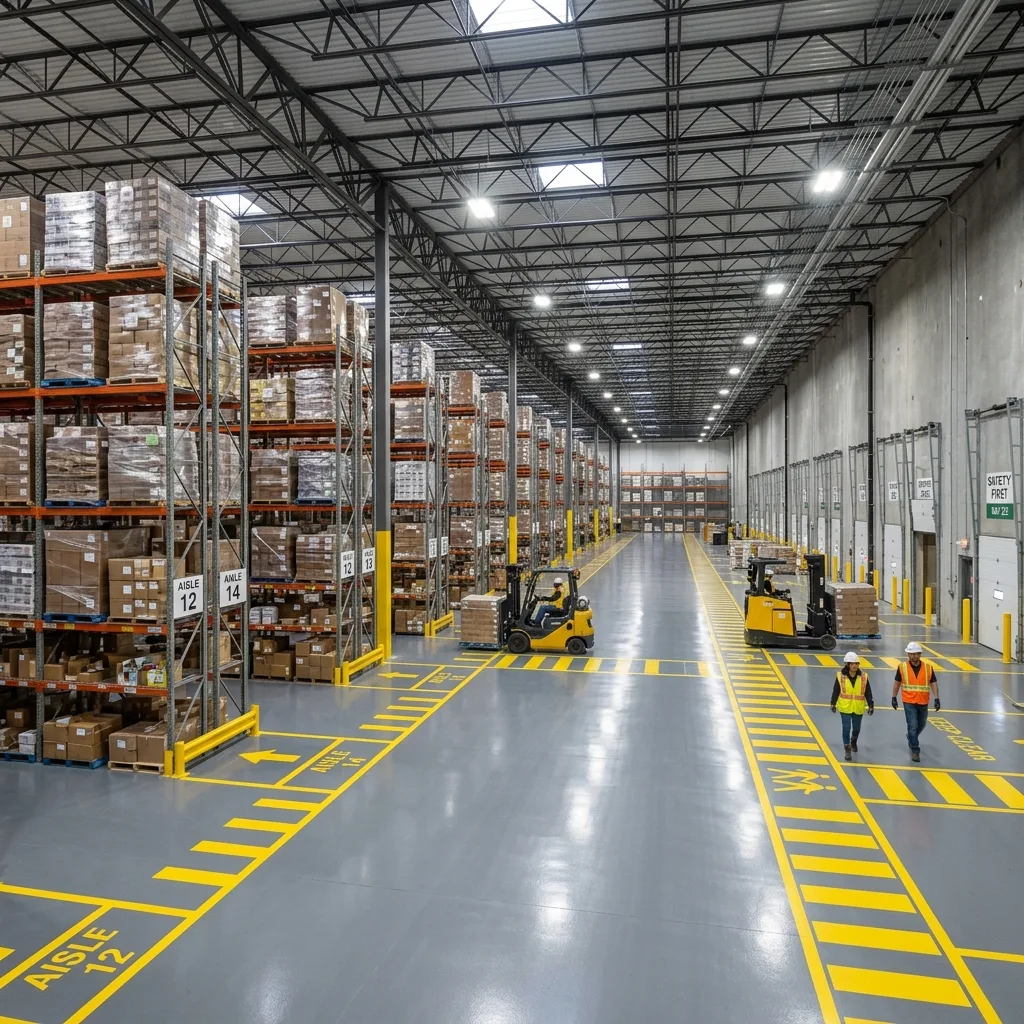
Serving federal-supply distribution, food processors, and manufacturing clients across the National Capital Region, Ottawa Epoxy Flooring installs shot-blast-prepared 100% solid broadcast epoxy systems in manufacturing plants, distribution centres, food processing facilities, and automotive dealerships throughout Ottawa, ON. CFIA-compliant seamless chemistry, integrated aisle line marking, and coved base detailing are the standard build, rated for forklift traffic, pallet jack loads, and concentrated chemical spills.
Industrial floors fail when the coating specification does not match the actual load and chemistry. A 40 to 60% solids waterborne epoxy at 4 to 6 mils DFT shrinks 30 to 50% on cure, which leaves a film thinner than specified and susceptible to shear delamination under forklift caster wheels rated to 12,000+ lbs. Hydraulic fluid, industrial degreasers, and fuel oil degrade polyurethane topcoats rated only for dilute chemical splash within months of daily contact. CFIA-regulated food processing and pharmaceutical facilities carry an additional requirement layer: seamless surfaces with no cracks, no grout joints, and no topcoat chemistry that absorbs food-contact residue.
Typical commercial floors run 2,000 to 50,000 sq ft and wrap in off-hours shifts so production never stops. Installed pricing runs $10 to $15 per sq ft depending on broadcast depth, topcoat specification, and surface prep requirement. WSIB-certified crews carry $2M liability and provide full compliance documentation.
Coverage runs across the NCR from central Ottawa through Kanata, Nepean, Orleans, Barrhaven, Stittsville, Manotick, Vanier, Rockcliffe, and out into Gatineau, Kemptville, Arnprior, Rockland, and Carp.
When a Commercial Floor Fails, Operations Stop
Commercial floor failure is not an aesthetic problem. In a food facility, a cracked or porous floor fails a health inspection. In a warehouse, deteriorating concrete creates trip hazards and equipment damage. In a hospital corridor, a floor that cannot be properly sanitized becomes a liability. And every repair pulls production time your operation cannot spare.
Three causes account for almost every commercial floor failure we are called in to fix: wrong system for the chemistry, inadequate surface prep, or a solvent-based product that was never built for the load it was asked to carry. A properly specified 100% solid commercial epoxy over shot-blast prep with the right topcoat chemistry outlasts its warranty. As Ottawa’s full-spectrum epoxy flooring contractor, we specify to the facility, from warehouse floor systems through chemical-resistant production zones.
100% Solids vs Solvent-Based: The Specification That Matters Most
Solids content is the single most misrepresented line item in a commercial flooring quote. A 100% solids epoxy contains no carrier solvent, so every gram of mixed material converts to cured film. A solvent-based or water-borne product releases 20 to 40% of its volume as vapour during cure, which leaves a film that is thinner, more porous, and less able to resist the point loads Class II and Class III forklifts apply.
Across a 50,000 sq ft warehouse slab, the difference between a 3 mm build from a true 100% solids product and a 1.5 mm film from a solvent-based substitute translates directly into years of service life. Pull-off adhesion tests to ASTM C1583 on 100% solids systems over properly shot-blasted concrete at CSP 3 to 4 profile (per the International Concrete Repair Institute standard) consistently produce substrate failure rather than adhesive failure. The epoxy bond is stronger than the concrete itself.
Health and safety is the other dimension. Solvent-based coatings release volatile organic compounds during application and cure. Inside occupied or semi-occupied facilities across Ottawa’s industrial parks, that off-gassing creates WSIB-relevant air quality concerns and can force extended ventilation windows. Zero-VOC 100% solids systems apply, cure, and hand back without those restrictions, which is exactly why they are the baseline specification for institutional contracts in Ontario.
What is Included in Every Commercial Epoxy Contract
- Detailed site survey and line-item RFQ
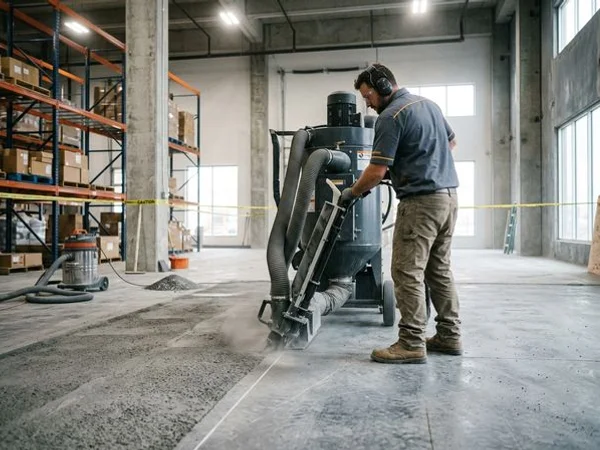
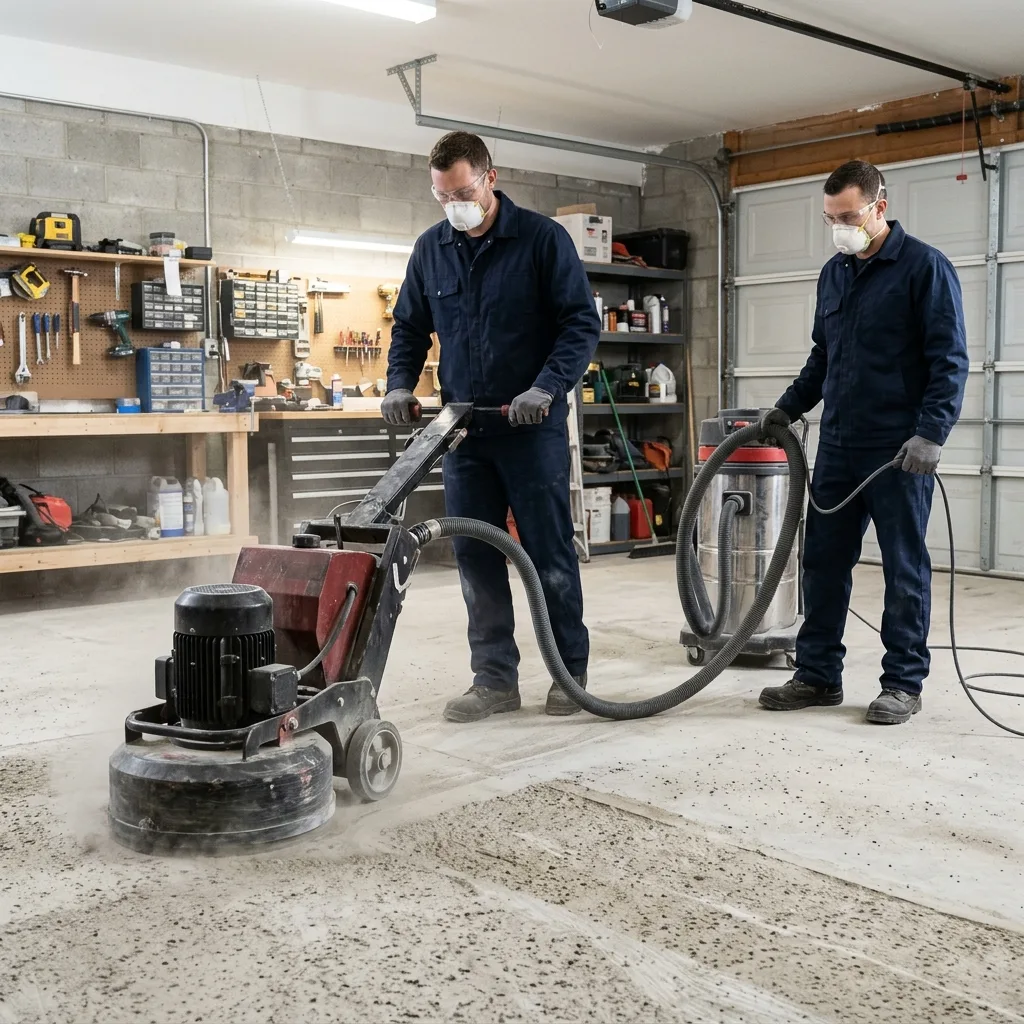
- Full shot-blast or diamond-grind surface preparation
- Substrate repair and crack stitching as needed
- 100% solid commercial-grade epoxy systems
- Sanitary commercial coving (4-6” up the wall) where required
- Chemical- and impact-resistant topcoats matched to the facility
- Line marking and safety striping
- Off-hours scheduling around your shifts
- Full compliance documentation (WSIB, insurance, CFIA where applicable)
Commercial Coving for Food Plants and Medical Facilities
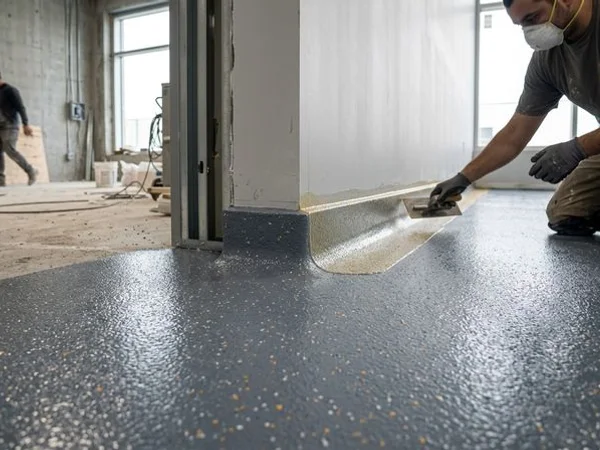
Commercial coving is a reinforced radius base that runs seamlessly from the floor up the wall, typically 4 to 6 inches, eliminating the right-angle joint at the wall-floor intersection. In food processing and pharmaceutical facilities subject to Canadian Food Inspection Agency audit, that joint is specifically cited as a harbourage point for bacteria, chemical cleaning residue, and pest infiltration.
The coving mortar is a 100% solids epoxy aggregate blend that is trowel-applied and reinforced at the radius. Topcoat over the cove matches the floor system, whether that means novolac epoxy for strong-acid or strong-caustic cleaning regimens, or aliphatic polyurea where UV stability under overhead skylights is required.
Coving is not optional in Ottawa’s food manufacturing facilities. It is a built-in facility design requirement. Beyond food plants, coving specifications extend into pharmaceutical production areas, hospital sluice rooms, and commercial kitchens. Any environment where the floor sees a daily mop, pressure wash, or hose gets a coving benefit because standing liquid at the wall-floor joint is eliminated entirely. The investment is modest, roughly $2 to $4 per linear foot, but the liability reduction for a facility under CFIA inspection is significant.
Off-Hours Installs: Protecting Your Production Schedule
A full shot-blast prep, base coat, broadcast, and topcoat commercial system requires a minimum of two coats and the cure window between them. On a 100% solids system at typical Ottawa facility temperatures of 15 to 22 degrees Celsius, the recoat window opens at 8 to 12 hours and return-to-traffic for pedestrian and light wheel loads is 24 hours. Rapid-cure polyaspartic topcoats compress return-to-traffic to as short as 4 to 6 hours. That means a two-coat system with a polyaspartic finish goes down overnight and hands back for the day shift the next morning.
For larger facilities along Merivale Road, Hunt Club, or the Kanata business parks, we sequence the work in zones. Zone 1 is prepped, coated, and handed back before Zone 2 begins, so the facility never goes fully offline. A 30,000 sq ft warehouse is typically sequenced across three to four overnight windows without a single lost daytime shift.
Off-hours scheduling carries a modest labour premium, typically 10 to 15% above standard daytime rates, but that number is almost always smaller than the cost of a single lost operational day for an Ottawa distribution or manufacturing facility. Our WSIB certification and $2M liability insurance satisfy the compliance documentation required for institutional contracts.
Chemical and Impact Resistance for Industrial Environments
Chemical resistance is not uniform across commercial epoxy formulations. Standard 100% solid bisphenol-A epoxy handles the chemistry present in most light manufacturing and warehouse environments: petroleum oils, hydraulic fluid, mild alkalis, and dilute cleaning agents. Battery charging rooms are the classic exception, where sulphuric acid splash from lead-acid fork truck batteries is a documented exposure. The correct specification there is novolac epoxy, which offers tighter cross-link density and resists concentrated acids, aromatic solvents, and elevated temperatures up to roughly 120 degrees Celsius.
Impact resistance is measured by the ASTM D2794 Gardner impact test. Commercial epoxy systems with broadcast quartz aggregate carry significantly higher impact values than neat epoxy films because the aggregate spreads point load across a larger footprint. In facilities where steel-wheeled carts or dropped pallets are routine, a 3 to 4 mm quartz broadcast at 80 to 100 mesh density delivers the impact resistance required without giving up chemical resistance. Broadcast also delivers an R11 to R13 slip resistance rating, which reduces WSIB slip-and-fall exposure in wet processing environments.
Polyurethane Cement: When Standard Epoxy Is Not Enough
Polyurethane cement is a hybrid system, Portland cement aggregate bound in a polyurethane matrix, that handles two conditions standard epoxy cannot: continuous moisture vapour transmission from below-grade slabs, and sustained thermal shock from hot wash-down water or steam cleaning above 60 degrees Celsius. Inside a food processing facility where the floor sees 82-degree wash-down twice a day, standard epoxy delaminates within months. Polyurethane cement’s thermal expansion coefficient more closely matches concrete, and it bonds effectively to damp substrates.
The trade-off is cost and workability. Polyurethane cement systems price at roughly $14 to $22 per square foot installed depending on system build and coving requirements, versus $8 to $14 for a comparable 100% solids epoxy spec. For dry warehouse environments, automotive service floors, or office-adjacent manufacturing spaces, standard 100% solids epoxy delivers better value at equivalent durability. Both systems are on the menu. Which one gets specified comes out of the site survey, not out of which product carries the higher margin.
Commercial Epoxy Flooring Costs in Ottawa
Commercial epoxy in Ottawa runs approximately $6 to $18 per square foot installed. The low end covers a single-coat 100% solids system on a clean, lightly trafficked slab in good condition. The high end covers a multi-coat novolac or polyurethane cement system with full shot-blast prep, crack stitching, perimeter coving, broadcast aggregate, chemical-resistant topcoat, and line marking in a food or pharmaceutical facility.
Five cost drivers dominate every quote: surface condition, system chemistry, coving requirements, project timing, and square footage. Surface condition is the most variable. A contaminated slab requiring multiple blast passes, degreasing, and crack repair can add $1.50 to $3.00 per square foot before a drop of epoxy hits the concrete.
Every quote is line-item: material, prep, coving, labour, and scheduling. On a 15,000 sq ft food plant with 400 linear feet of perimeter coving and a novolac topcoat system, the realistic all-in budget lands at $12 to $16 per square foot. A straightforward 8,000 sq ft warehouse with a clean slab, daytime access, and a standard broadcast quartz system lands closer to $7 to $9 per square foot.
Questions Facility Managers Ask
How long does commercial epoxy last in a warehouse environment?
A properly specified 100% solids epoxy system over a shot-blasted CSP 3 to 4 profile carries a realistic service life of 10 to 20 years before a topcoat refresh is required. The substrate bond does not degrade. What wears is the topcoat film under abrasion from forklift traffic. Refreshing the topcoat at year 10 to 12 costs roughly 30 to 40% of the original install and extends the system life another decade.
Can commercial epoxy be installed in winter
Yes, with appropriate conditions management. Epoxy chemistry requires a substrate temperature above 10 degrees Celsius and a slab temperature at least 3 degrees above the dew point. Inside a heated facility, winter installation is straightforward. In unheated facilities or new construction shells, temporary heat gets brought in to condition the slab to the minimum working temperature before application begins.
Do you handle the compliance documentation for institutional contracts?
Yes. Commercial and institutional contracts routinely require proof of WSIB clearance, a Certificate of Insurance naming the owner as additional insured, and CFIA system documentation for food facilities. Every one of those is packaged as part of the contract deliverables. WSIB clearance certificates are included in every handover package.
Our Commercial Epoxy Results in Ottawa
Commercial Epoxy Pricing
Industrial scope varies widely. We provide a line-item quote after a site visit.
Why Ottawa Customers Choose Ottawa Epoxy Flooring for Commercial Epoxy
Shift-Aware Scheduling
Nights, weekends, and staggered zone work built around your production calendar so daytime output never pauses.
Zero-VOC Solid Chemistry
Commercial-grade resin systems that skip the solvent thinning trick used to hit lower price points.
Federal-Ready Compliance
WSIB clearance, $2M CGL coverage, and paperwork sized for institutional and NCR federal contracts.
Owned Shot-Blast Fleet
Our crew hauls the prep gear in on our own trucks. Nothing on the prep phase gets subcontracted.
How Commercial Epoxy Works
Site Survey & RFQ
A site visit covers traffic patterns, chemistry, and coving requirements, then a detailed line-item RFQ comes back.
Shot-Blast Prep
Full shot-blast surface profile creates the mechanical bond point for a 100% solids system on industrial slabs.
Coving + Base + Topcoat
Sanitary coving goes in first where the facility requires it. Then a 100% solid base coat and a chemical-resistant topcoat matched to the environment.
Off-Hours Handover
Work is scheduled around your shift pattern. The floor is ready for daytime traffic the following morning.
Ready for a Free On-Site Assessment?
Same-day quotes across Ottawa. WSIB-certified, $2M liability on every project.
What Customers Say About Our Commercial Epoxy
"Kanata auto parts distribution centre coated off-hours. Shot-blast to CSP 3, 100% solids base, novolac topcoat. Three years of Class II forklift traffic and zero delamination."
"Full WSIB documentation and $2M liability were required for our Gatineau food plant contract. Everything delivered plus CFIA-compliant sanitary coving run 6 inches up the wall. Passed our first inspection clean."
"Nepean auto parts distribution centre, 24/7 forklift traffic on a 12,000 sq ft floor. Ottawa Epoxy shot-blast to CSP 4, laid down a novolac-resistant high-build system, and had every WSIB and $2M liability doc on file before day one. Two years of heavy traffic in and not a single delamination."
Commercial Epoxy FAQs
Can the floor go in without shutting our operation down?
Yes. Every commercial project is scheduled around 24-hour off-hours windows, whether that means overnights, weekends, or multi-shift sequencing. Daytime operations keep running throughout. For chemical-resistant or rapid-cure specifications, the floor is often handed back ready for traffic within hours of the final coat.
Which chemistries will the floor handle?
System spec follows the actual chemistry on the floor. A standard 100% solid epoxy takes care of most cleaning agents, oils, and mild acids. For aggressive exposures like battery acid, aromatic solvents, or hot caustics, we shift to novolac epoxy or polyurethane cement.
Do you install sanitary coving for food and medical facilities?
Yes. Seamless commercial coving runs 4 to 6 inches up the wall to eliminate the wall-floor joint where bacteria and cleaning residue collect. It is standard on CFIA-compliant food facilities, commercial kitchens, and medical floors.
What warranty comes with a commercial system?
Warranty runs 5 to 10 years on the system, with the exact term tied to chemistry, traffic profile, and any extended terms negotiated into specific institutional contracts. Full terms are laid out in the contract.
Can you handle large square footage?
Yes. Warehouses, distribution centres, and institutional facilities across the National Capital Region are our regular scope. Very large or phased projects get sequenced in zones so operations continue during the install.
Are you insured for institutional contracts?
Yes. WSIB certified, $2M liability insurance, and Canadian Inspection Agency certified. Full documentation is provided for municipal and institutional bidding.
What per-square-foot budget should I plan for commercial epoxy in Ottawa?
Realistic installed pricing across the NCR runs $6 to $18 per square foot. System complexity, surface condition, coving requirements, and off-hours scheduling all move the number. A basic 100% solid broadcast quartz on a clean warehouse slab sits at the low end. A coved novolac system on a food plant with crack repair pushes the high end. A site visit and a line-item RFQ come first so there are no surprises.
What is the difference between 100% solids and solvent-based commercial epoxy?
100% solids epoxy contains no carrier solvent, so every gram of material becomes part of the cured film. That gives you a true 3 to 4 mm build in one coat, genuine zero-VOC emissions, and a film density that resists heavy point loads from forklift wheels. Solvent-based products give up 20 to 40% of their volume as the carrier evaporates, which leaves a thinner and more porous film that typically fails sooner under industrial traffic.
How long does a large Ottawa warehouse install take?
A typical 10,000 sq ft warehouse with shot-blast prep, base coat, broadcast aggregate, and topcoat wraps in 2 to 3 overnight shifts. Larger facilities are sequenced in zones so one half stays operational while the other coats. Rapid-cure polyaspartic topcoats can compress return-to-traffic to 4 to 6 hours after the final coat.
What surface profile does commercial epoxy require?
The industry standard is Concrete Surface Profile CSP 3 to 5 as defined by the International Concrete Repair Institute. Shot blasting reliably reaches that profile on existing slabs. Anything below CSP 3, such as what acid etching alone leaves behind, is inadequate for a 100% solid system under heavy industrial traffic and is a leading cause of delamination.
Does polyurethane cement outperform epoxy on industrial floors?
Polyurethane cement beats standard epoxy in environments with frequent thermal cycling or hot wash-down water above 60 degrees Celsius, and it bonds directly to damp concrete. But it also costs roughly 30 to 50% more per square foot and is overkill for dry warehouse environments. Our specific recommendation for polyurethane cement is food processing areas, commercial kitchens, and any zone subject to steam cleaning or direct thermal shock.
Do you install CFIA-compliant flooring for Ottawa food facilities?
Yes. CFIA-compliant installs require seamless sanitary coving 4 to 6 inches up the wall, a topcoat impermeable to cleaning chemicals, and a system that tolerates the sanitisers used in food processing. System specification, material data sheets, and cure verification all ship in the handover package for facilities under Canadian Food Inspection Agency audit.
Commercial & Industrial Epoxy Flooring by city
Local pages with area-specific detail across the NCR:
Commercial & Industrial Epoxy Flooring in Ottawa
Local commercial epoxy for Ottawa homes and businesses.
Learn more →Commercial & Industrial Epoxy Flooring in Kanata
Local commercial epoxy for Kanata homes and businesses.
Learn more →Commercial & Industrial Epoxy Flooring in Nepean
Local commercial epoxy for Nepean homes and businesses.
Learn more →Commercial & Industrial Epoxy Flooring in Barrhaven
Local commercial epoxy for Barrhaven homes and businesses.
Learn more →Commercial & Industrial Epoxy Flooring in Orleans
Local commercial epoxy for Orleans homes and businesses.
Learn more →Commercial & Industrial Epoxy Flooring in Gatineau
Local commercial epoxy for Gatineau homes and businesses.
Learn more →Commercial & Industrial Epoxy Flooring in Rockcliffe Park
Local commercial epoxy for Rockcliffe Park homes and businesses.
Learn more →Commercial & Industrial Epoxy Flooring in Vanier
Local commercial epoxy for Vanier homes and businesses.
Learn more →Commercial & Industrial Epoxy Flooring in Westboro
Local commercial epoxy for Westboro homes and businesses.
Learn more →Commercial & Industrial Epoxy Flooring in The Glebe
Local commercial epoxy for The Glebe homes and businesses.
Learn more →Related Services
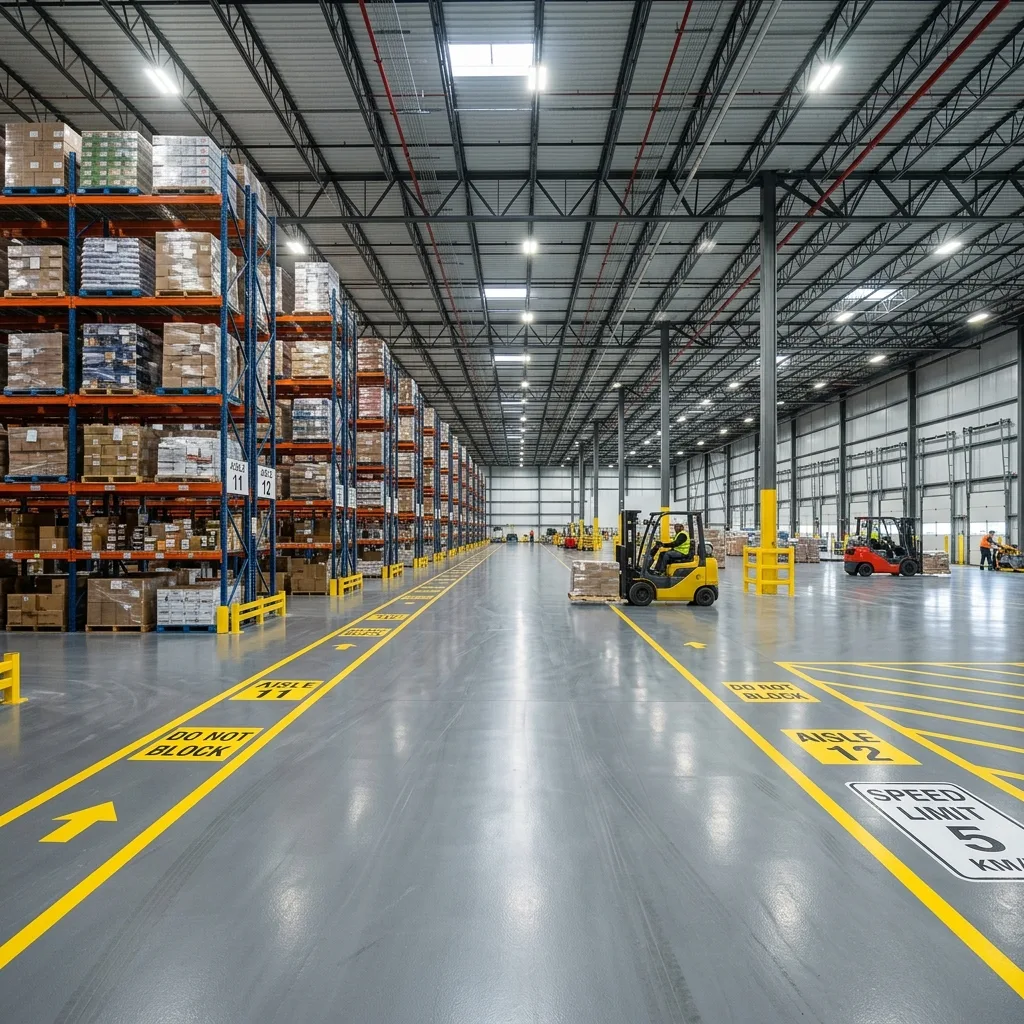
Warehouse Epoxy Flooring in Ottawa & the National Capital Region
Forklift-rated 100 percent solid epoxy systems with shot-blast prep, chemical-resistant topcoat, and embedded aisle marking for NCR distribution centres, logistics hubs, and federal warehouse operations. From $3 to $7 per sq ft installed, phased weekend windows keep operations running, WSIB-certified crews and $2M liability on every commercial project.

Commercial Kitchen Epoxy Flooring in Ottawa & the National Capital Region
For NCR restaurants and food-service operators, we build CFIA-compliant seamless epoxy floors with 4 to 6 inch integral coving, quartz anti-slip broadcast, and zero-VOC chemistry. Installed pricing typically sits at $5 to $11 per sq ft, with most kitchens wrapped inside two overnight shifts. Health-inspection documentation and off-hours scheduling are standard on every project.
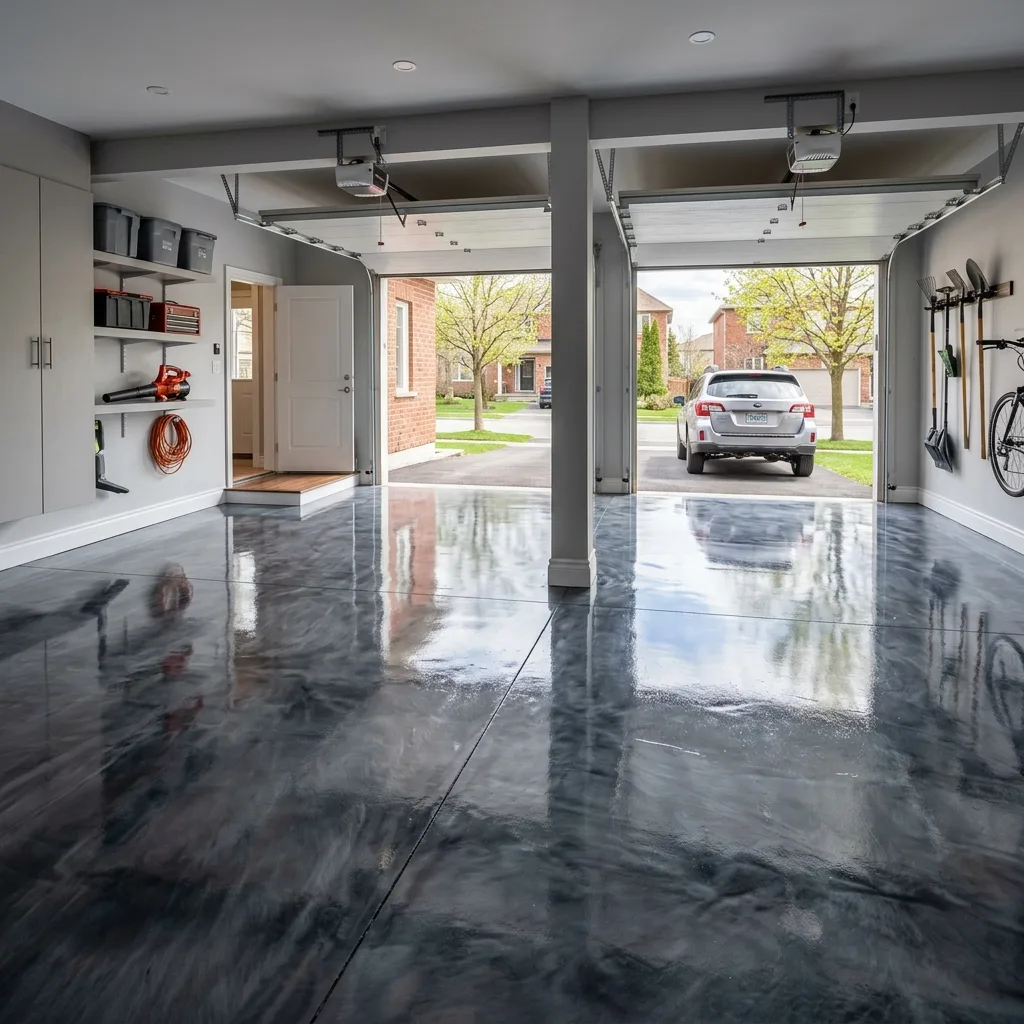
Concrete Polishing in Ottawa & the National Capital Region
Progressive diamond grinding up to 1,500-grit sealed with a lithium silicate densifier produces a polished concrete surface that reflects light and eliminates any wax or topcoat schedule. Installed pricing runs $3 to $8 per sq ft; most commercial floors are complete inside 2 to 3 days. Retail, restaurant, and federal office builds in the NCR pick polishing for its 20-year-plus lifespan.
Ready to Book Commercial Epoxy?
Same-day free on-site assessment. WSIB-certified, $2M liability on every project.