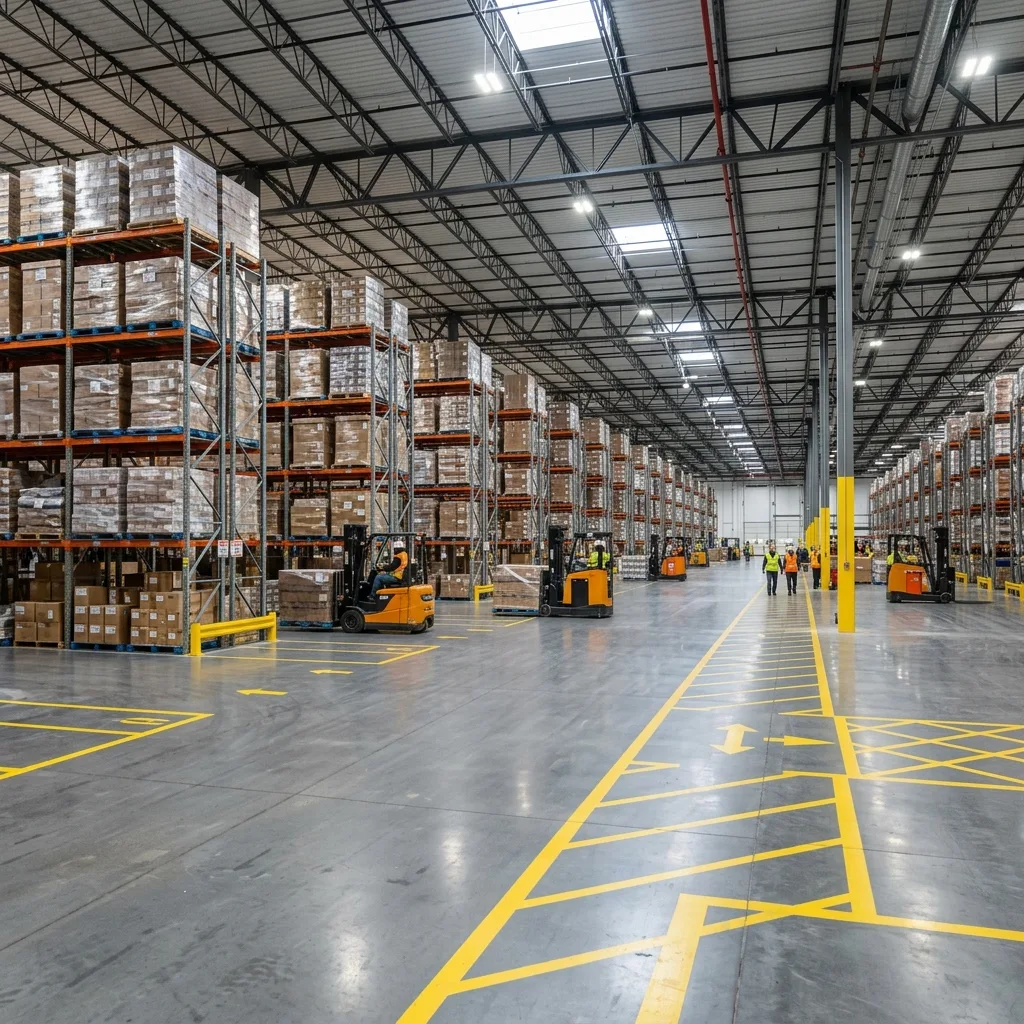
Industrial Epoxy Flooring in Ottawa & the National Capital Region - Warehouse, Manufacturing & Chemical-Resistant Systems
For NCR industrial operators, Ottawa Epoxy Flooring installs high-build broadcast epoxy, urethane cement, novolac chemical-resistant systems, polyurea coatings, TSSA-compliant secondary containment, and ANSI/ESD S20.20 conductive floors. We work in manufacturing plants, distribution and logistics warehouses, food processing facilities, automotive service operations, and chemical storage environments across Ottawa. Every project is specified against the actual loading, chemical exposure, and compliance requirements on site, whether that means Class 1 to 3 forklift rating, CFIA seamless-surface requirements for food plants, TSSA containment compliance, or ESD control for electronics manufacturing.
Industrial floors take punishment that commercial and residential epoxy systems were never designed for. A Class 3 forklift running at 6,000 to 10,000 kg capacity puts more than 300 PSI of contact pressure at each drive-wheel patch. That kind of shear will rip a 40 to 60 percent solids epoxy off a CSP 2 slab within months. Almost every industrial floor failure we are called to inspect is a surface preparation failure, not a coating failure. CSP 3 diamond grinding or 1 to 3 mm shot blasting is the floor for any surface that will carry forklift or heavy-equipment traffic. Total system build depth of 80 to 100 mils across four to six layers bridges hairline slab cracking and delivers the durability industrial operators actually need.
Industrial epoxy in Ottawa runs from $5 per sq ft on open-plan warehouse work with shot-blast prep up to $20 per sq ft on novolac chemical-resistant systems delivered with full compliance documentation. Heavy-duty manufacturing floors typically land at $5.50 to $10 per sq ft. Urethane cement and wash bay systems run $9 to $14. Secondary containment and chemical storage coatings run $12 to $20. Projects range from 1,000 sq ft equipment pads to distribution centres above 200,000 sq ft.
Ottawa Epoxy Flooring provides industrial epoxy flooring across the National Capital Region, including Kanata, Nepean, Orleans, Barrhaven, Stittsville, Gatineau, Kemptville, Arnprior, Rockland, Carp, and Manotick.
Industrial Epoxy Flooring in Ottawa
Ottawa Epoxy Flooring is Ottawa’s industrial epoxy flooring contractor. We install high-build broadcast systems, urethane cement, novolac chemical-resistant floors, and secondary containment coatings for manufacturing plants, distribution warehouses, food processing facilities, and chemical storage operations across the National Capital Region. Every industrial project starts at CSP 3 surface preparation, the single decision that determines whether your floor lasts 15 years under forklift traffic or fails in 12 months.
Industrial Epoxy Services We Install
- Commercial & Industrial Epoxy - 80 to 100 mil high-build broadcast, Class 1 to 3 forklift rated
- Warehouse Epoxy Flooring - distribution centres, logistics hubs, pallet racking areas
- Secondary Containment Coatings - TSSA, Ontario Reg 675/98, CCME compliant
- ESD Conductive Epoxy - ANSI/ESD S20.20 for electronics manufacturing
- Wash Bay & Washdown Epoxy - urethane cement, rated for 82 C hot pressure wash
- Automotive Service Bay Epoxy - oil-decontaminated, hoist-pad reinforced
- Cold Storage & Freezer Epoxy - polyurea for minus 40 C cryogenic service
- Commercial Kitchen Epoxy - CFIA food plant seamless surface
- Parking Garage & Hangar Epoxy - ASTM C672 tested, polyurea traffic membrane
What Industrial Epoxy Costs
Industrial epoxy in Ottawa spans $5 per sq ft on open-plan warehouse work up to $20 per sq ft on novolac chemical-resistant systems with full compliance paperwork. Projects range from 1,000 sq ft equipment pads to distribution centres above 200,000 sq ft.
Why NCR Industrial Facilities Need Heavy-Duty Floor Specification
Ottawa’s industrial corridors along Highway 417, the Nepean industrial parks, and the Kanata business parks house manufacturing operations, distribution hubs, and food processing facilities that demand flooring built for heavy equipment, chemical exposure, and 24-hour operating schedules. Standard commercial epoxy at 25 to 30 mils is fine for office corridors and retail, but it cannot handle the 300 PSI plus contact pressures a Class 3 forklift drive wheel produces every day in NCR logistics operations.
The local geology adds a second problem. Slab-on-grade concrete poured on Leda clay in Nepean, Kanata, and Barrhaven industrial parks routinely returns elevated moisture vapour readings because the clay drains poorly and older buildings were built without vapour barriers. ASTM F2170 in-situ moisture testing is mandatory on every industrial job we quote. Coating failure from undetected moisture drive is the most common reason industrial epoxy in Ottawa fails inside its first two years. On top of that, NCR winters push 80 to 100 freeze-thaw cycles through unheated warehouse slabs. Loading dock thresholds are the usual failure point, where thermal movement at control joints cracks rigid coatings that lack the depth to bridge it.
Durability Under Heavy Equipment and Forklift Traffic
Our epoxy floor coating systems are engineered for long-term strength under industrial loading. Every install uses forklift-rated 100% solids epoxy with 3,000 to 6,000 psi compressive strength. Material handling equipment, pallet racking, and constant traffic move across the floor without chipping or delamination.
Prep includes CSP 3-5 shot blasting for a proper surface profile, delivering deep mechanical adhesion and longer service life. Properly prepped and installed, these floors typically hold up more than 15 years under Class 2 to 3 forklift traffic, cutting replacement cycles and shrinking long-run maintenance budgets.
Chemical and Abrasion Resistance
Many NCR industrial environments deal with daily exposure to oils, hydraulic fluid, and cleaning chemistry. Our epoxy coatings, and the urethane topcoats optioned over them, form a seamless barrier that resists corrosive substances and staining, tested to ASTM D1308 for chemical immersion resistance.
Combining epoxy with a polyurethane topcoat delivers superior scratch and abrasion performance. Where concentrated acids or solvents are on the exposure list, novolac epoxy provides the chemical crosslink density that standard bisphenol-A epoxy cannot maintain under long-term immersion.
Advanced Industrial Flooring Solutions
Quartz Broadcast and High-Build Systems
Forklift-rated 100% solids epoxy with compressive strength between 3,000 and 6,000 psi goes down after ASTM F2170 moisture testing and CSP 3-5 shot blasting. Every project runs to a written schedule, including off-hours and section-by-section installs that minimise production downtime.
Polished Concrete for Industrial Facilities
For projects that need a floor without a coating layer, we deliver mechanical polished concrete systems that improve appearance and hardness at once. Mixed-use facilities often combine polished concrete in low-traffic offices and corridors with epoxy broadcast in forklift aisles and loading zones under the same project scope.
Slip Resistance and Safety Features
Silica aggregates or textured topcoats are matched to each workspace, boosting slip resistance in wet or oil-prone zones under ASTM D2047 coefficient-of-friction testing. Safety lines, zone markings, and high-visibility borders are embedded under the final topcoat, protecting them from forklift wear and cleaning chemistry.
Professional Installation Process
Surface Preparation and Moisture Mitigation
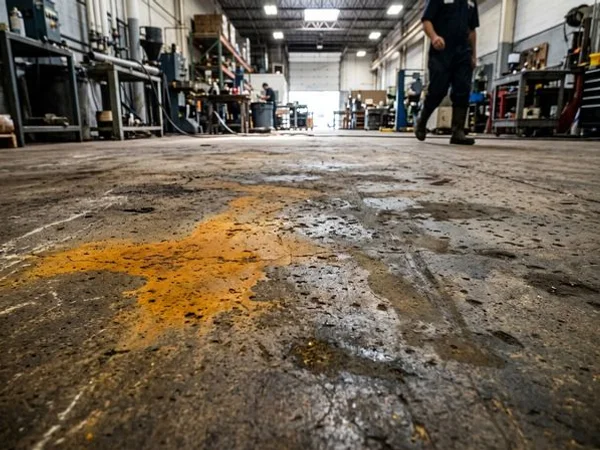
Every project starts with a detailed concrete assessment. Diamond grinding or CSP 3-5 shot blasting removes contaminants. Heavily contaminated substrates get petroleum decontamination pre-treatment before the shot blast. ASTM F2170 moisture testing confirms slab readiness. Leda clay substrates in the local industrial corridors frequently return elevated readings in slab-on-grade construction, which makes moisture mitigation primers essential.
Section-by-Section Scheduling
Manufacturing and distribution operators do not have the luxury of downtime. Section-by-section installs and off-hours shifts are the norm. For facilities in the 50,000 to 200,000 sq ft range, a written schedule documents each work section, install date, cure timeline, and traffic access date before the project starts.
Related Questions Industrial Facility Managers Ask
Why does industrial epoxy fail in some warehouses and not others?
Prep. The most common cause is applying industrial epoxy over a CSP 1 or CSP 2 surface that cannot deliver the mechanical adhesion forklift loading demands. Second most common is moisture, specifically ASTM F2170 readings elevated by the Leda clay substrates under most local industrial buildings. Third is oil contamination that was never ground past. All three are preparation failures, not product failures.
Can a 200,000 sq ft distribution centre get an epoxy floor without halting operations?
Yes. Forklift traffic patterns, picking routes, and dock door usage are mapped first, then the floor is broken into sections that can be isolated from active operations during overnight and weekend shifts. A 200,000 sq ft facility typically installs in 5,000 to 10,000 sq ft sections across 20 to 40 overnight shifts, with each section available for forklift traffic 48 to 72 hours after install.
Which ASTM standards govern industrial epoxy performance in Ontario?
The key standards are ASTM F2170 (in-situ concrete RH testing), ASTM D1308 (chemical resistance by immersion), ASTM D4060 (abrasion resistance by Taber abraser), ASTM D2047 (slip resistance), and ASTM D4259 (surface preparation of concrete). ANSI/ESD S20.20 governs ESD applications. CFIA RCP 2019 governs seamless-surface and coving requirements in food processing. Applicable standards are referenced in the compliance documentation handed over at project close.
Industrial Epoxy Pricing
Loading spec, chemical resistance rating, and compliance documentation drive the final number.
Why Ottawa Customers Choose Ottawa Epoxy Flooring for Industrial Epoxy
80 to 100 Mil Build, Not 25 to 30 Mil
Thin 25 to 30 mil systems cannot handle forklift wheel shear. We build 80 to 100 mils total across four to six layers, bridging hairline slab cracking and taking Class 1 to 3 forklift contact pressure north of 300 PSI.
CSP 3-5 Verified Before Any Coat
Almost every industrial floor failure we inspect is a prep failure. CSP 2 does not provide the mechanical adhesion heavy equipment demands. We confirm CSP 3 or higher with a profile gauge before any primer goes down.
Shot Blasting for Oil-Contaminated Slabs
Diamond grinding on its own cannot pull petroleum out of concrete pore structure. Oil-contaminated facilities need petroleum decontamination pre-treatment plus 1 to 3 mm shot blasting to reach uncontaminated concrete.
Section-by-Section Off-Hours Scheduling
Large NCR distribution centres cannot shut down for a week. We map production zones and forklift traffic patterns first, then install in 5,000 to 10,000 sq ft sections during overnight and weekend shifts.
How Industrial Epoxy Works
Loading & Chemical Exposure Assessment
Forklift class and axle weight, chemical exposure profile, ASTM F2170 moisture testing, slab condition and compressive strength, and a section-by-section schedule mapped to your production calendar.
CSP 3-5 Shot Blasting & Contamination Removal
1 to 3 mm shot blasting for oil-contaminated substrates, petroleum decontamination pre-treatment where the substrate demands it, HEPA dust collection, and CSP gauge verification before any primer is opened.
High-Build System Application
Moisture-tolerant primer, 100% solids epoxy base coat, broadcast aggregate or flake, 80 to 100 mils of total build depth for forklift-rated applications, urethane or polyaspartic topcoat matched to chemical exposure.
Safety Marking & Compliance Documentation
Safety lines and zone markings installed, adhesion and thickness tests recorded, compliance package assembled (CFIA, TSSA, ANSI/ESD S20.20 as applicable), forklift access timeline confirmed at handover.
Ready for a Free On-Site Assessment?
Same-day quotes across Ottawa. WSIB-certified, $2M liability on every project.
What Customers Say About Our Industrial Epoxy
"80,000 sq ft distribution centre in Nepean, forklifts running 24 hours a day, zero tolerance for downtime. Ottawa Epoxy mapped our production zones and traffic pattern first, then ran the install section by section across three weeks of overnight shifts. Every zone handed back on time. Two years later the floor is holding up under Class 3 traffic with no delamination or cracking anywhere."
"Manufacturing plant in Stittsville exposed daily to hydraulic fluid and industrial cleaner. Two previous epoxy jobs failed inside 18 months from chemical delamination. Ottawa Epoxy pulled the failed coating, ran ASTM F2170 moisture testing, and spec'd a urethane topcoat over a 100% solids epoxy base to match our chemical profile. Full production cycle since, no chemical damage."
"Automotive parts facility in Kanata with thirty years of oil in the slab. Two prior contractors tried to grind and coat without decontamination and both failed inside a year. Ottawa Epoxy ran petroleum decontamination, shot blasted to CSP 4 to get below the contaminated layer, then applied a moisture-tolerant primer because the moisture test came back high. Three winters in and the floor still shows zero delamination."
Industrial Epoxy FAQs
Which industrial epoxy systems does Ottawa Epoxy install?
High-build broadcast epoxy (80 to 100 mils for Class 1 to 3 forklift traffic), urethane cement for hot washdown and alkaline cleaning zones, novolac chemical-resistant systems, polyurea coatings, TSSA-compliant secondary containment, ANSI/ESD S20.20 conductive floors, and cold-storage polyurea systems. We serve manufacturing, warehousing, food processing, and chemical storage facilities across Ottawa and the NCR.
How much does industrial epoxy flooring cost in Ottawa?
Budget $5 per sq ft on open-plan warehouse epoxy up to $20 per sq ft on novolac chemical-resistant systems with compliance documentation. Heavy-duty manufacturing floors typically run $5.50 to $10. Urethane cement and washdown-rated systems run $9 to $14.
How thick does industrial epoxy need to be for forklift traffic?
Class 1 to 3 forklift traffic calls for 80 to 100 mils of total system build across four to six layers. Thin 25 to 30 mil systems appropriate for office and retail cannot survive forklift wheel shear. CSP 3 diamond grinding or shot blasting removes the laitance layer and produces the mechanical bond profile needed under heavy equipment loading.
What surface preparation is required for industrial epoxy?
CSP 3 diamond grinding or 1 to 3 mm shot blasting at minimum. Most of the industrial floor failures we get called to inspect are adhesion failures rooted in inadequate prep, not coating chemistry. Surface profile is confirmed with a CSP gauge before any primer or base coat is applied.
Can industrial epoxy go in without shutting down the facility?
Yes. Industrial projects are staged section by section during off-hours, overnights, and weekends so operations keep running. Facilities in the 20,000 to 200,000 sq ft range are installed in 5,000 to 10,000 sq ft sections, typically one section per overnight shift.
How long does industrial epoxy flooring last in Ottawa?
High-build systems with CSP 3 prep run 10 to 20 years under forklift and heavy equipment traffic. Urethane cement in hot washdown and food processing environments holds up 8 to 15 years. Chemical-resistant novolac in acid and solvent exposure runs 10 to 20 years depending on exposure frequency.
How do industrial epoxy, urethane cement, and polyaspartic differ for industrial use?
Industrial epoxy (100% solids, 80 to 100 mil build) is the standard for forklift-rated warehouse and manufacturing floors. Urethane cement is the right system for hot washdown zones where thermal shock from steam or boiling washdown would crack rigid epoxy. Polyaspartic is used as a fast-cure topcoat over an epoxy base coat where UV stability and rapid return to service matter.
How soon can forklifts return to the floor?
Foot traffic is fine 12 to 18 hours after the final topcoat. Forklift and heavy equipment traffic goes back on the floor 48 to 72 hours after install, depending on ambient temperature and product formulation. Section-by-section scheduling allows partial reopening as each zone cures while adjacent sections are still under construction.
Which systems are rated for chemical resistance to oils, solvents, and acids?
For oils, hydraulic fluids, and industrial cleaners: 100% solids epoxy with a urethane topcoat, tested to ASTM D1308. For concentrated acids and strong solvents: novolac epoxy or vinyl ester, with ASTM D1308 immersion test results. Abrasion resistance is rated separately under ASTM D4060 (Taber abraser). All three ratings are specified at the site assessment.
How do finish options affect safety line visibility?
High-gloss epoxy improves light reflectivity in warehouse and manufacturing spaces. Safety lines and pedestrian or vehicle zone markings are embedded under the final topcoat, which protects them from forklift wear and chemical cleaning that would erase surface-applied paint within months. Bright contrasting colours meet Ontario occupational health and safety visibility standards.
Industrial Epoxy Flooring by city
Local pages with area-specific detail across the NCR:
Industrial Epoxy Flooring in Ottawa
Local industrial epoxy for Ottawa homes and businesses.
Learn more →Industrial Epoxy Flooring in Kanata
Local industrial epoxy for Kanata homes and businesses.
Learn more →Industrial Epoxy Flooring in Nepean
Local industrial epoxy for Nepean homes and businesses.
Learn more →Industrial Epoxy Flooring in Barrhaven
Local industrial epoxy for Barrhaven homes and businesses.
Learn more →Industrial Epoxy Flooring in Orleans
Local industrial epoxy for Orleans homes and businesses.
Learn more →Industrial Epoxy Flooring in Gatineau
Local industrial epoxy for Gatineau homes and businesses.
Learn more →Industrial Epoxy Flooring in Rockcliffe Park
Local industrial epoxy for Rockcliffe Park homes and businesses.
Learn more →Industrial Epoxy Flooring in Vanier
Local industrial epoxy for Vanier homes and businesses.
Learn more →Industrial Epoxy Flooring in Westboro
Local industrial epoxy for Westboro homes and businesses.
Learn more →Industrial Epoxy Flooring in The Glebe
Local industrial epoxy for The Glebe homes and businesses.
Learn more →Related Services
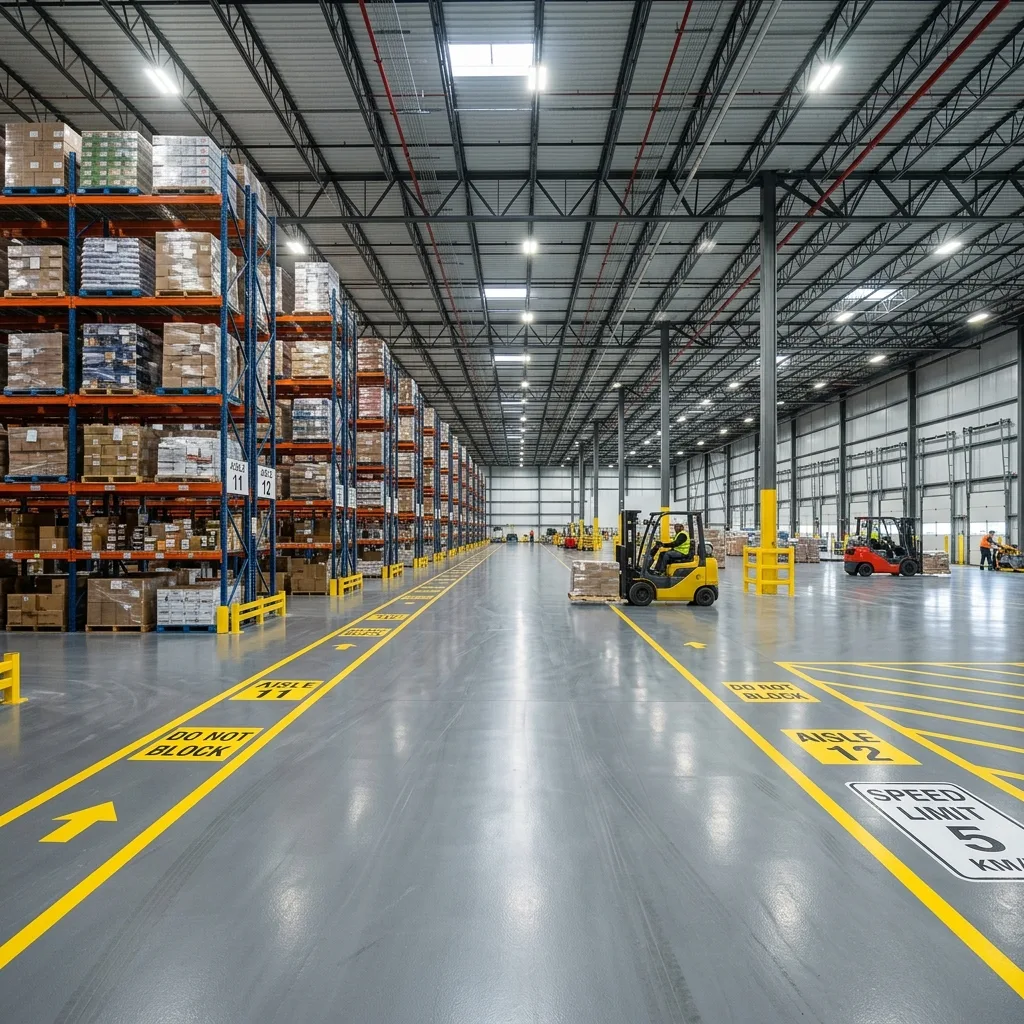
Warehouse Epoxy Flooring in Ottawa & the National Capital Region
Forklift-rated 100 percent solid epoxy systems with shot-blast prep, chemical-resistant topcoat, and embedded aisle marking for NCR distribution centres, logistics hubs, and federal warehouse operations. From $3 to $7 per sq ft installed, phased weekend windows keep operations running, WSIB-certified crews and $2M liability on every commercial project.
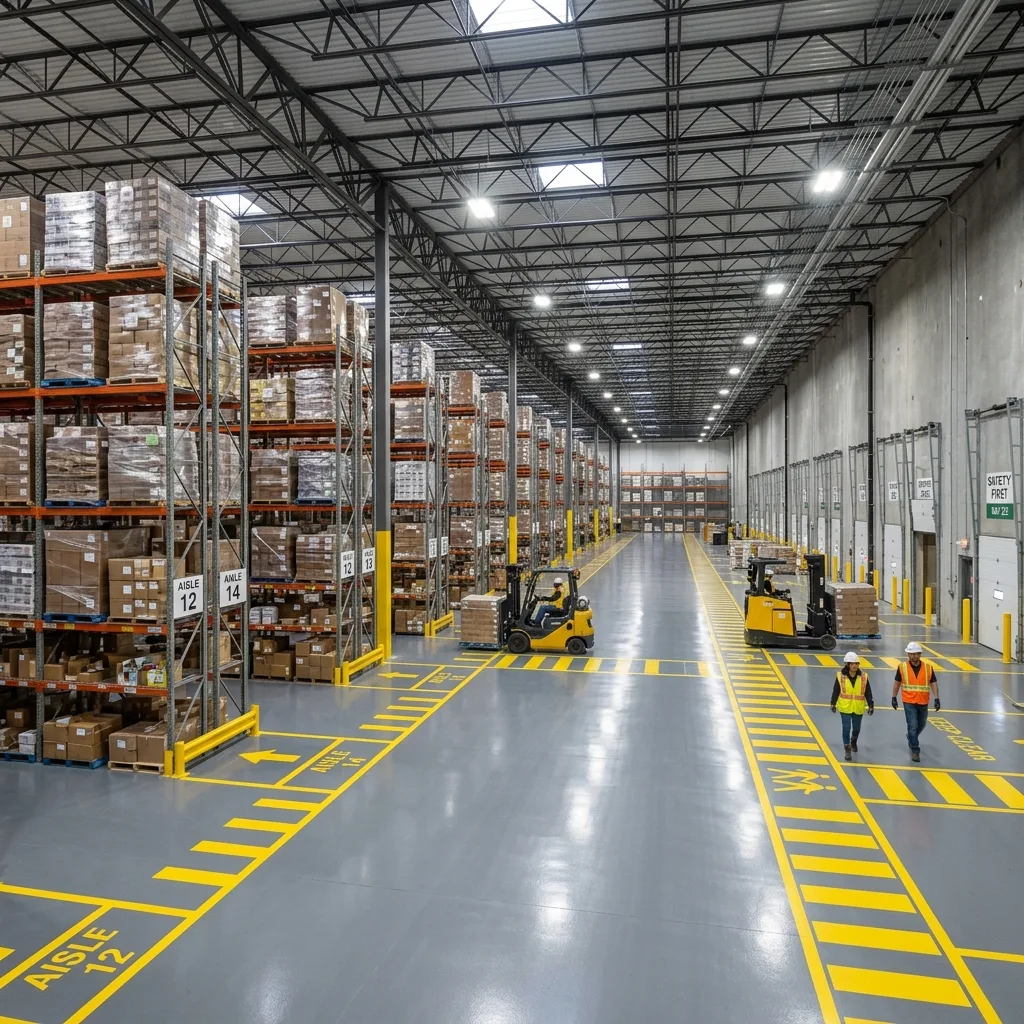
Commercial & Industrial Epoxy Flooring in Ottawa & the National Capital Region
Shot-blasted 100% solid commercial-grade epoxy systems built for manufacturing plants, distribution centres, and 24-hour food operations across Ottawa. Installed pricing runs $10 to $15 per sq ft with off-hours scheduling that returns your floor before the next shift starts. WSIB-certified crews, $2M liability, and full compliance documentation on every project.
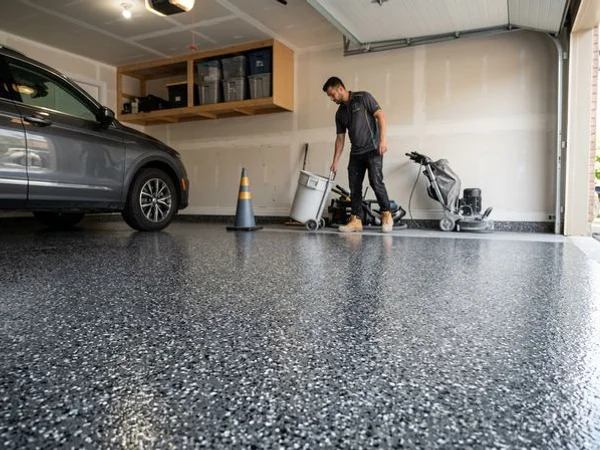
Automotive Service Bay Epoxy Flooring in Ottawa & the National Capital Region
Broadcast quartz and polyaspartic epoxy systems built for dealership service departments, quick-lube facilities, and independent workshops across the National Capital Region. Hoist pad reinforcement, petroleum decontamination, and ASTM D2047 anti-slip aggregate on every bay. Installed pricing sits between $6 and $12 per sq ft. Bay-by-bay overnight scheduling keeps the shop open. WSIB-certified with $2M liability.
Secondary Containment Coatings in Ottawa & the National Capital Region
Immersion-rated novolac epoxy, vinyl ester, and polyurea secondary containment coatings for fuel tank berms, chemical storage rooms, transformer pads, and industrial spill floors across Ottawa and the NCR. TSSA-compliant, chemical-profile-specific specifications. From $10 to $18 per sq ft installed with full compliance documentation, WSIB certification, and $2M liability on every project.
ESD Conductive Epoxy Flooring in Ottawa & the National Capital Region
Anti-static and conductive epoxy floors for federal facilities, Kanata electronics manufacturers, and NCR data centres. Copper grounding grid, ANSI/ESD S20.20 spec, megohmmeter-verified at handover. Installed cost $7 to $14 per sq ft, with a signed compliance report on every job.
Ready to Book Industrial Epoxy?
Same-day free on-site assessment. WSIB-certified, $2M liability on every project.