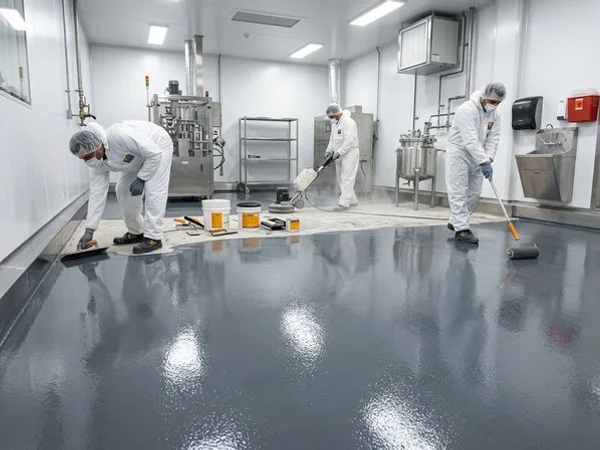
Pharmaceutical Cleanroom Epoxy in Ottawa & the National Capital Region - GMP & ISO-Rated Floor Systems
For GMP pharmaceutical manufacturers, compounding pharmacies, API synthesis operators, and Health Canada-licensed drug premises across the NCR, Ottawa Epoxy Flooring installs ISO-classified cleanroom floor systems, novolac chemical-resistant base coats, and ESD-dissipative topcoats. Every cleanroom scope uses zero-VOC, zero-particle-emission chemistry, section-by-section overnight sequencing to preserve classification integrity, and post-installation particle count verification to ISO 14644-1.
Pharmaceutical operators run under Health Canada Good Manufacturing Practices and ISO 14644 cleanroom classification thresholds that standard epoxy coatings cannot meet. Floors inside ISO 5 to 8 environments must produce zero particle shed under foot traffic and equipment wheels, and standard broadcast flake systems are ruled out because individual chips generate particulate that fails ISO count limits. Chemical resistance to isopropyl alcohol, sodium hypochlorite, peracetic acid, and hydrogen peroxide vapour at pharmaceutical concentrations degrades ordinary polyurethane topcoats within 12 months of daily cleaning cycles.
Most cleanroom scopes fall between 500 and 5,000 sq ft and complete in phased overnight shifts to hold facility certification throughout the work. Installed pricing runs $12 to $20 per sq ft based on ISO tier, ESD specification, chemical resistance requirements, and documentation package depth. GMP installation records, material safety data sheets, and post-installation ISO 14644-1 particle count results ship with every project.
Coverage extends across Ottawa proper and into Kanata, Nepean, Orleans, Barrhaven, Stittsville, Gatineau, Kemptville, Arnprior, and Rockland.
Pharmaceutical Cleanroom and GMP Epoxy Flooring in Ottawa
Ottawa Epoxy Flooring installs GMP-compliant seamless floor systems for Health Canada-licensed pharmaceutical manufacturers, compounding pharmacies, API synthesis labs, and ISO-classified cleanrooms across the National Capital Region. Novolac epoxy base coats and ESD-dissipative topcoats meet ISO 14644-1 particle count thresholds, GMP installation documentation standards, and the chemical resistance demands of daily pharmaceutical-grade cleaning cycles.
What Is Pharmaceutical Cleanroom Epoxy Flooring?
Cleanroom epoxy is a seamless, zero-particle-emission floor system engineered for ISO 14644-1 classification in pharmaceutical and life sciences environments. Where standard broadcast flake or quartz systems shed particles, cleanroom flooring uses smooth, impermeable novolac epoxy surfaces that stay non-shedding under foot traffic and equipment wheel contact.
What Does a GMP Cleanroom Floor System Include?
- CSP 3 diamond-ground surface preparation
- Novolac epoxy base coat with resistance to IPA, peracetic acid, and H2O2
- ESD-dissipative topcoat inside the 10^6 to 10^9 ohm range
- Integral sanitary wall coving at 4 to 6 inches
- Post-installation particle count verification to ISO 14644-1
- Complete GMP material traceability and installation records
How Much Does Pharmaceutical Cleanroom Flooring Cost?
Installed pricing in Ottawa runs $12 to $20 per sq ft based on ISO tier, ESD specification, chemical resistance rating, and the documentation package. Most scopes fall between 500 and 5,000 sq ft.
Why the NCR Pharmaceutical Sector Needs Specialist Cleanroom Flooring
Ottawa and the surrounding National Capital Region host a growing pharmaceutical and life sciences cluster, anchored by the Kanata tech corridor, federal health agencies, and a distributed network of compounding pharmacies and API synthesis operators across Nepean and Orleans. These facilities run under Health Canada GMP and ISO 14644 requirements that standard commercial epoxy cannot satisfy. A floor that looks perfectly acceptable to a general contractor will fail a Health Canada Drug Premises Inspection when the chemistry sheds particles, the topcoat softens under daily IPA cleaning, or the installation documentation fails to support GMP traceability.
Ottawa’s substrate conditions add another dimension. Many pharmaceutical facilities in the region occupy slab-on-grade industrial units built on Leda clay, where moisture vapour emission through the concrete runs elevated. ASTM F2170 testing before coating is mandatory here, not optional. Novolac epoxy laid over a slab with excessive moisture drive will osmotic-blister inside the first year, a failure that voids the cleanroom floor and forces a full re-installation.
Novolac Epoxy Systems with Superior Chemical Resistance
Our novolac epoxy systems carry a higher crosslink density than bisphenol-A epoxies. That tighter molecular structure improves resistance to isopropyl alcohol, peracetic acid, hydrogen peroxide vapour, and sodium hypochlorite at 10,000 ppm. These properties are essential inside ISO 14644-1 Class 5 to 8 cleanrooms and any environment running frequent sterilisation cycles.
| Property | Performance | Relevance |
|---|---|---|
| Chemical Resistance | Excellent against IPA, H2O2, sodium hypochlorite | Meets GMP cleaning protocols |
| Crosslink Density | Higher than bisphenol-A epoxy | Extends sterilant durability |
| VOC Content | Zero | Supports installation in occupied cleanrooms |
ESD-Dissipative Flooring for Static-Sensitive Areas
Pharmaceutical and biotech facilities running instrumentation, weighing cells, or automated filling systems require ESD-dissipative epoxy flooring. Our topcoats hold resistivity inside the 10^6 to 10^9 ohm range, draining static charges safely without the overconductivity that disrupts sensitive electronics.
This system deploys into GMP production suites and API synthesis areas to prevent static-driven particulate lift or ignition in solvent zones. Post-installation ESD compliance testing confirms performance. Ionic conductive pathways handle the charge dissipation rather than carbon fibre or flake additives, so no particle-shedding media enters the coating and ISO 14644-1 counts remain compliant.
Resin Flooring for Compounding Pharmacies and API Synthesis
For compounding pharmacies and API synthesis operators, resin flooring pairs seamless installation with precise chemical performance. The result is a monolithic floor compatible with compounding isolators, laminar flow benches, and solvent handling areas.
The epoxy stands up to aggressive reagents while staying smooth and easy to sanitise. Zero-particle-emission chemistry means the system does not compromise airborne particulate counts during or after cure. Orleans compounding pharmacies and Nepean API synthesis facilities represent the type of operations where this specification is the only compliant option.
Particle Control and Post-Installation Verification
Zero-particle-emission chemistry and seamless installation eliminate trapped contaminant pathways in ISO 5 to 8 environments. After cure, particle count verification documents compliance and supports Health Canada Drug Premises Inspection requirements. These verifications confirm the surface meets ISO particulate limits under both static and dynamic conditions.
Broadcast flake contamination is avoided by prohibiting loose decorative media in pharmaceutical zones. Where texture is required, controlled silica or aluminium oxide slip additives with validated particle capture performance carry the load.
Installation Process for Active Pharmaceutical Facilities
Operating pharmaceutical facilities cannot absorb full shutdowns. Phased section-by-section scheduling in overnight sequences keeps operations continuous. Each section completes, cures, and is particle-verified before the next zone opens.
Temporary barriers, negative-air units, and HEPA filtration isolate work areas to protect ISO 5 to 8 environments during installation. Typical planning covers one 1,000 to 1,500 sq ft section per night depending on facility traffic and HVAC constraints. Cleanroom supervisors receive daily progress logs, and post-installation verification confirms floors meet ISO particle count thresholds before handoff.
Long-Term Maintenance for Regulated Sites
Facility teams receive training on validated cleaning solutions compatible with novolac epoxy topcoats. Daily wet cleaning with neutral pH detergents extends surface life and preserves the ESD dissipation range at 10^6 to 10^9 ohms.
Every six months, floors should undergo surface resistance testing and optical inspection for microcracks or coating fatigue. Novolac epoxy in regulated pharmaceutical environments typically calls for topcoat recoating every 8 to 10 years depending on traffic and sterilant frequency. WSIB-certified crews handle touch-up or full recoat services with minimal downtime.
Related Questions Pharmaceutical Facility Managers Ask
How does pharmaceutical cleanroom epoxy differ from standard commercial epoxy?
Standard commercial epoxy uses bisphenol-A chemistry and often includes broadcast flake or quartz aggregate. Both are prohibited in ISO-classified cleanroom environments. Bisphenol-A epoxy degrades inside 12 months under daily IPA and hypochlorite cycles. Pharmaceutical cleanroom epoxy uses smooth novolac chemistry, a higher crosslink density, zero aggregate media, and a zero-VOC formulation that can be applied in occupied cleanrooms without disturbing air classification.
What GMP documentation does the installation produce?
Every pharmaceutical cleanroom project ships with ASTM F2170 moisture logs, CSP surface profile measurements, material safety data sheets and product traceability records for every coating component, installation phase logs, and post-installation ISO 14644-1 particle count verification results. That package satisfies Health Canada Drug Premises Inspection recordkeeping requirements.
Do compounding pharmacies need cleanroom-grade flooring?
Yes, when the pharmacy operates under NAPRA sterile compounding standards (USP 797 or the provincial equivalent), the compounding area must have a smooth, impermeable, non-particle-shedding floor. Standard vinyl composite tile and commercial epoxy with decorative flake both fail that standard. Compounding pharmacies that received DPIR citations for flooring porosity or surface cracks are our most common referral source.
Pharma Cleanroom Epoxy Pricing
ISO classification tier and ESD specification affect final price.
Why Ottawa Customers Choose Ottawa Epoxy Flooring for Pharma Cleanroom Epoxy
Novolac, Not Bisphenol-A
Novolac chemistry with a tighter crosslink network resists IPA, peracetic acid, and hydrogen peroxide where standard bisphenol-A epoxy softens inside 12 months of daily cleaning.
No Broadcast Flake, No Particle Risk
Broadcast flake sheds particles that fail ISO 14644-1 counts. Our smooth novolac systems produce zero particulate under equipment wheels or foot traffic.
Particle Count Verification Included
ISO 14644-1 particle count testing after cure is part of every project. Classification is confirmed before handover, not assumed.
Classification Holds Through Installation
Overnight section sequencing with negative-air isolation and HEPA filtration keeps adjacent classified areas in compliance. No full-facility shutdown.
How Pharma Cleanroom Epoxy Works
ISO Classification Assessment
Cleanroom tier, GMP documentation requirements, ESD specification, and chemical exposure profile documented before system selection.
CSP 3 Prep & Moisture Testing
Diamond grinding to CSP 3 profile, ASTM F2170 in-situ RH testing on Leda clay slabs, and full substrate documentation before coating.
Phased Overnight Application
Zero-VOC novolac base coat, ESD-dissipative topcoat, and integral coving applied in overnight sections with HEPA isolation and negative-air units.
Particle Count Verification & GMP Handover
ISO 14644-1 particle count testing after cure, complete GMP material traceability records, and compliance package delivered at handover.
Ready for a Free On-Site Assessment?
Same-day quotes across Ottawa. WSIB-certified, $2M liability on every project.
What Customers Say About Our Pharma Cleanroom Epoxy
"We run a GMP pharmaceutical manufacturing facility in Kanata and needed flooring capable of passing a Health Canada Drug Premises Inspection. The team specified a novolac epoxy with an ESD-dissipative topcoat, installed it across phased overnight sections, and delivered the GMP documentation package our Quality team required. Post-install particle count landed inside ISO 7 limits. Production continued uninterrupted throughout."
"Our Orleans compounding pharmacy was flagged for surface porosity at inspection. The existing tile came out and a seamless novolac epoxy system went in, with the material traceability records Health Canada wanted. Overnight installation across three sections, and after two years the floor is still holding through daily IPA and sodium hypochlorite cycles."
"Nepean API synthesis lab, strict requirements on peracetic acid and hydrogen peroxide vapour resistance. The Ottawa crew specified the right novolac chemistry and ran the CSP 3 prep properly. ESD-dissipative topcoat tested in the correct ohm range for our sensitive weighing cells, and the validation team accepted the GMP documentation without questions."
Pharma Cleanroom Epoxy FAQs
Which epoxy chemistry is required in pharmaceutical cleanrooms?
ISO 5 to 8 cleanroom floors need novolac epoxy base coats for chemical resistance to IPA, peracetic acid, and hydrogen peroxide vapour, paired with a zero-particle-emission topcoat. ESD-dissipative chemistry is layered in where electrostatic discharge control is required. Broadcast flake systems are not compliant.
How does novolac epoxy compare to bisphenol-A for pharmaceutical floors?
Novolac resins run a higher crosslink density than bisphenol-A systems, producing tighter molecular bonds and superior chemical and sterilant resistance. Bisphenol-A epoxy softens or discolours inside 12 months under daily IPA, peracetic acid, or hydrogen peroxide exposure. Novolac systems return 10 to 20 year service life under the same regime.
What surface preparation does the coating require?
Every pharmaceutical cleanroom floor begins with CSP 3 diamond grinding to establish the anchor profile novolac epoxy needs. ASTM F2170 in-situ RH testing runs before coating to confirm slab humidity is inside tolerance. Both readings log into the GMP documentation package.
Can ESD-dissipative topcoats hold the 10^6 to 10^9 ohm range without compromising particle counts?
Yes. The ESD-dissipative topcoat holds resistivity between 10^6 and 10^9 ohms using ionic conductive pathways rather than carbon fibres or flake additives. No particle-shedding conductive media enters the formulation, so ISO 14644-1 counts remain compliant.
Which sterilants does the coating resist?
Novolac epoxy systems withstand isopropyl alcohol, sodium hypochlorite up to 10,000 ppm, peracetic acid, and hydrogen peroxide vapour (VHP) sterilization cycles.
Can a cleanroom floor be installed without shutting the facility down?
Yes. Phased section-by-section installation runs in overnight shifts to preserve cleanroom classification. Each section is isolated with temporary barriers, negative-air units, and HEPA filtration to protect neighbouring ISO-classified areas.
How much does pharmaceutical cleanroom epoxy cost in Ottawa?
Installed pricing runs $12 to $20 per sq ft across the NCR based on ISO tier, ESD specification, chemical resistance rating, and the depth of the GMP documentation package. Most cleanroom scopes fall between 500 and 5,000 sq ft.
Does the flooring meet Health Canada GMP requirements?
Yes. Every pharmaceutical floor project ships with complete GMP documentation, material traceability, installation records, ASTM F2170 moisture logs, CSP surface profile data, and post-installation ISO 14644-1 particle count verification.
What separates ESD-dissipative from conductive flooring in a pharma setting?
ESD-dissipative (10^6 to 10^9 ohms) suits most pharmaceutical environments. Conductive flooring (10^4 to 10^6 ohms) is deployed inside ATEX-classified zones with flammable solvent or API dust explosion risk. Facility classification is reviewed before the correct resistance tier is specified.
How long does the floor system last?
A properly installed novolac pharmaceutical system holds 10 to 20 years under daily GMP cleaning protocols. Topcoat recoat cycles at 7 to 10 years extend service life without requiring base coat removal.
Related Services
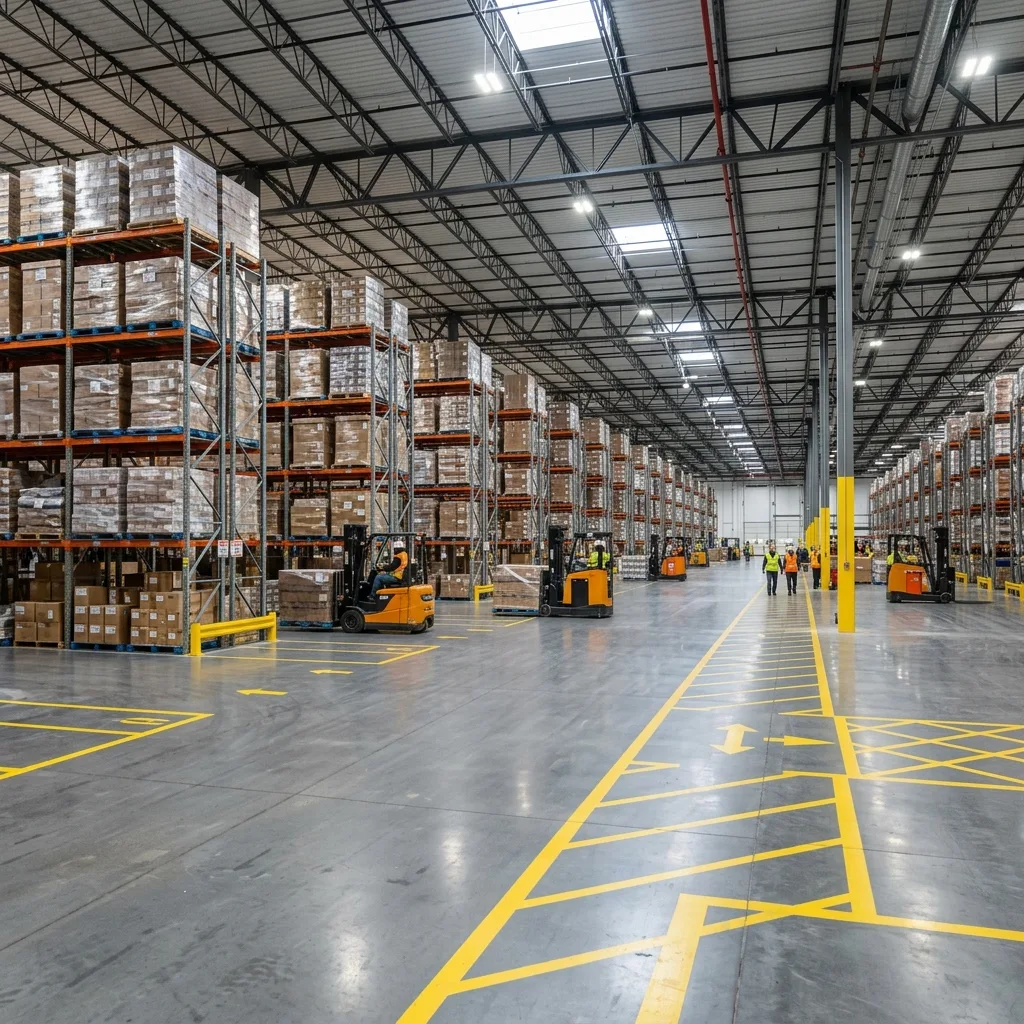
Commercial Epoxy Flooring in Ottawa & the National Capital Region
Commercial floor systems engineered around the regulatory frameworks that govern federal facilities, restaurants, hospitals, and tech-corridor manufacturing across the National Capital Region. CFIA-compliant kitchens, IPAC Canada coved medical floors, ISO 14644-1 cleanrooms, and high-crossing retail systems. Installed pricing from $5 per sq ft on open warehouses to $22 per sq ft on cleanroom builds. WSIB-certified, $2M liability, full compliance documentation.
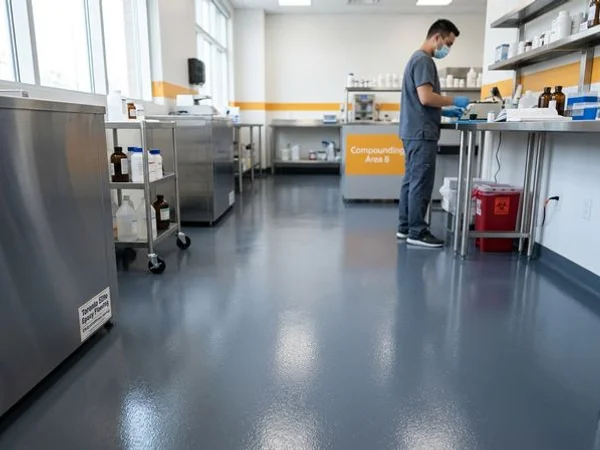
Laboratory Epoxy Flooring in Ottawa & the National Capital Region
Novolac chemical-resistant floor systems for federal research labs, university science facilities, clinical testing labs, and industrial materials analysis operations across the NCR. Rated against concentrated acids, bases, and solvents at real laboratory strength. Pricing runs $10 to $18 per sq ft installed. WSIB-certified, $2M liability, full compliance documentation.
ESD Conductive Epoxy Flooring in Ottawa & the National Capital Region
Anti-static and conductive epoxy floors for federal facilities, Kanata electronics manufacturers, and NCR data centres. Copper grounding grid, ANSI/ESD S20.20 spec, megohmmeter-verified at handover. Installed cost $7 to $14 per sq ft, with a signed compliance report on every job.
Institutional & Medical Epoxy Flooring in Ottawa & the National Capital Region
Seamless antimicrobial epoxy with 4 to 6 inch integral wall coving and zero-VOC chemistry for Ottawa hospitals, clinics, schools, and long-term care operators. Installed pricing $6 to $12 per sq ft; section-by-section scheduling keeps the facility running. WSIB-certified crews, $2M liability, and full IPAC Canada compliance paperwork on every project.
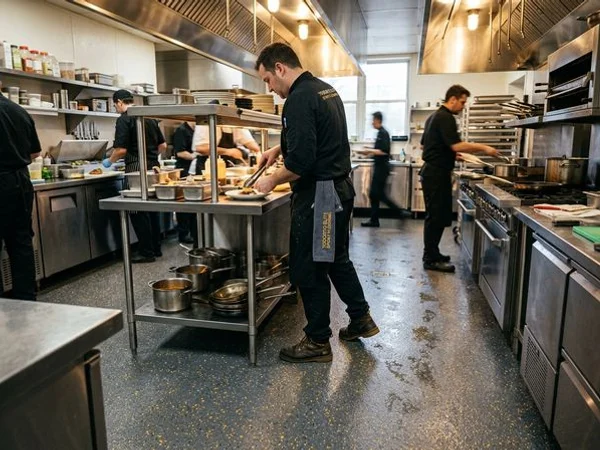
Commercial Kitchen Epoxy Flooring in Ottawa & the National Capital Region
For NCR restaurants and food-service operators, we build CFIA-compliant seamless epoxy floors with 4 to 6 inch integral coving, quartz anti-slip broadcast, and zero-VOC chemistry. Installed pricing typically sits at $5 to $11 per sq ft, with most kitchens wrapped inside two overnight shifts. Health-inspection documentation and off-hours scheduling are standard on every project.
Ready to Book Pharma Cleanroom Epoxy?
Same-day free on-site assessment. WSIB-certified, $2M liability on every project.