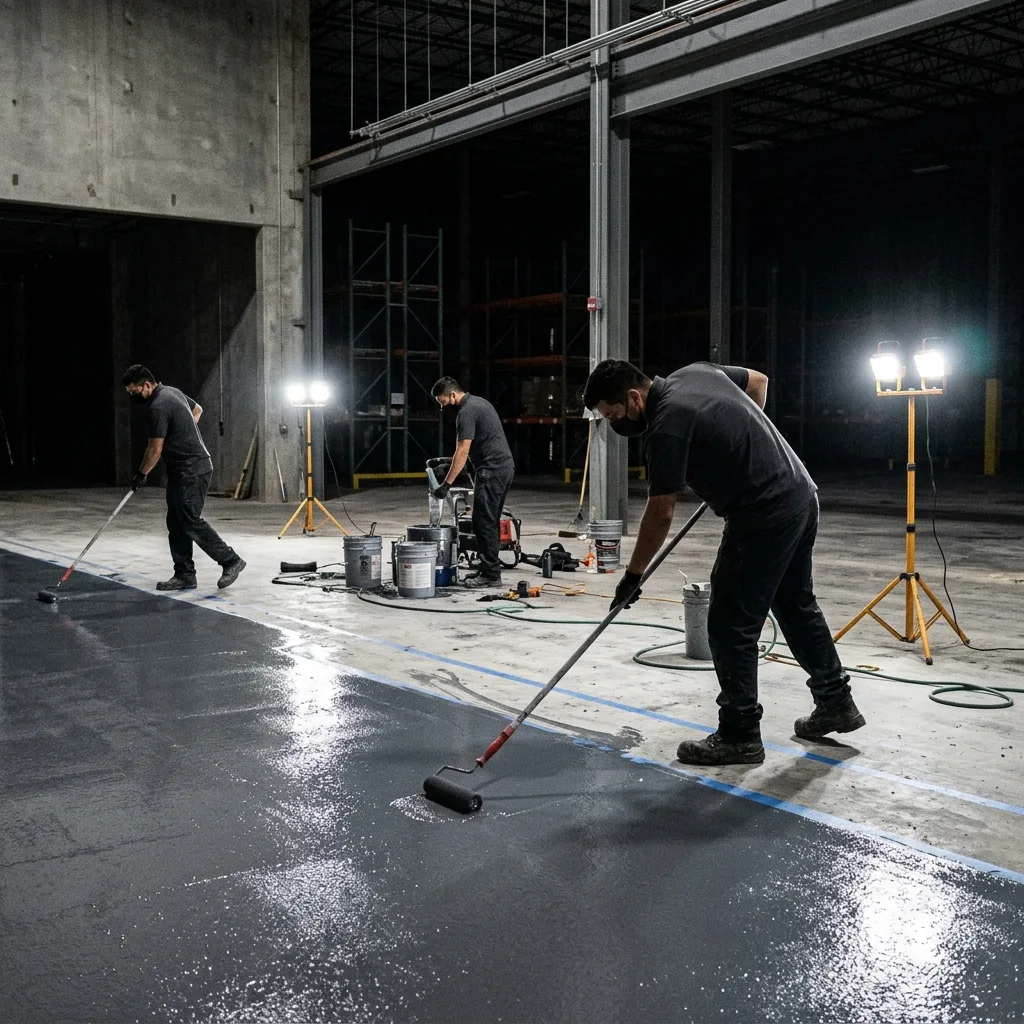
Concrete Repair & Restoration in Ottawa & the National Capital Region - Crack Stitching & Slab Professionals
Serving federal and residential clients across the National Capital Region, Ottawa Epoxy Flooring installs carbon-fibre crack staples, rapid-set polyurea crack fillers, epoxy mortar spall patching, and self-levelling underlayment on residential and commercial slabs throughout Ottawa, ON. Every repair assessment includes high-spot diamond grinding, expansion-joint evaluation, and ASTM F2170 moisture testing so the slab is confirmed profiled and dry enough for a permanent coating bond before any repair product is applied.
Concrete repair fails when the crew treats surface symptoms without testing what is happening below. Moisture vapour emission above 3 lbs per 1,000 sq ft per 24 hours (ASTM F1869), or relative humidity above 75% (ASTM F2170), will re-activate any cementitious patch applied on top and break the bond inside 12 to 18 months. Ottawa's freeze-thaw regime is among the harshest in Ontario. A 0.3 mm crack draws in water in autumn, freezes to 0.4 mm by January, and reaches 1 mm or more after five winters under slab movement and traffic loading. On slabs carrying vehicle or equipment loads, carbon-fibre stitching staples across transverse cracks (not polyurea fill on its own) are what actually stop propagation.
Repair scopes range from a 50 sq ft targeted spall patch through full-slab re-levelling on 5,000-plus sq ft commercial floors. Pricing runs $3 to $12 per sq ft, driven by crack density, spall depth, and moisture mitigation. Most residential repair projects wrap in one day. Large commercial re-levelling generally takes two to three days with phased access.
Ottawa Epoxy Flooring provides concrete repair and restoration to Ottawa, ON and surrounding communities, including Kanata, Nepean, Orleans, Barrhaven, Westboro, The Glebe, Stittsville, Manotick, Carp, Rockcliffe Park, Gatineau, Kemptville, and Arnprior.
Why Concrete Repair Comes Before Every Coating
Any coating is only as reliable as the slab under it. Cracks that move, spalls left unpatched, and slabs that are out of plane are the leading reasons epoxy floors fail. Most contractors skip this work to keep the quote low.
We do not. The substrate repair the slab actually needs is line-itemed into every coating quote, so the floor we install lasts the full warranty. As Ottawa’s full-spectrum epoxy flooring contractor, prep is never an afterthought. Concrete repair is also offered as a stand-alone service for owners who want raw concrete restored without a coating on top, and it is the first step in most epoxy floor repair and recoat jobs.
What is Included
- Visual and tactile damage assessment
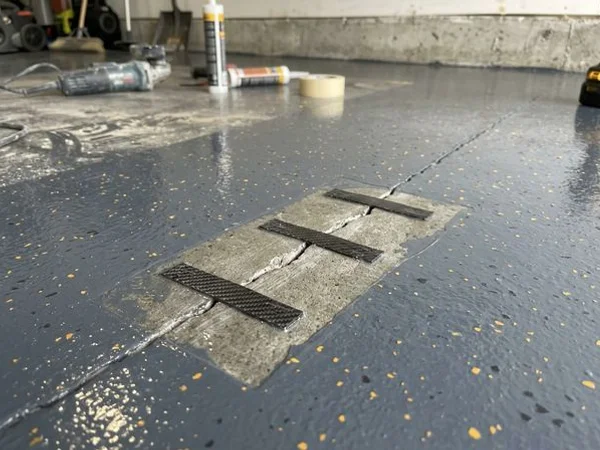
- Crack stitching with carbon fiber staples
- Rapid-set polyurea crack filling
- Epoxy mortar patches for spalls and corners
- Self-levelling underlayment for uneven slabs
- High-spot milling and expansion-joint detailing
- Final surface profile prep ready for coating
- Documented before/after for warranty
Ottawa Freeze-Thaw Cycling and Concrete Damage
Few Ontario climates hit concrete as hard as Ottawa. Between 80 and 100 freeze-thaw cycles land here per winter, compared with 45 to 55 in the southern Ontario corridor. Water enters hairline cracks in autumn, freezes and expands through winter, and each cycle opens the crack a measurable amount. What was a 0.3 mm crack after one summer becomes a 1 mm-plus structural concern after five Ottawa winters.
Road salt makes it worse. Calcium chloride and sodium chloride tracked into garages and warehouses migrate 3 to 5 mm into the concrete, accelerating the freeze-thaw spalling cycle and leaving chloride contamination that undermines coating adhesion. Any Ottawa concrete repair has to account for that salt penetration during prep by grinding past the contaminated layer before any repair product or coating primer is applied.
Then Leda clay adds a third layer: seasonal heave. As the clay absorbs and releases moisture through freeze-thaw, its volume changes measurably, applying lateral and vertical stress on slabs that were poured over inadequate sub-base preparation. Homes built between the 1950s and 1970s in Centretown, The Glebe, and Old Ottawa South are especially affected, and their basement and garage slabs often show a signature pattern of multiple parallel cracks running perpendicular to the longest slab dimension.
Crack Repair: Stitching vs Fill-Only
Every cracked slab starts with classifying the crack. Dormant hairline cracks under 1 mm are opened slightly with a crack-chaser blade and filled with a rapid-set semi-rigid polyurea. Active cracks, ones with measurable seasonal movement, require mechanical stitching using carbon-fibre staples spaced 6 to 10 inches apart perpendicular to the crack axis, then a flexible polyurea fill on top. Staple layout follows ICRI Technical Guideline 310.3 for structural crack repair.
Skip the staples and lean on fill alone, and the crack re-opens on the next thermal cycle. We have redone other contractors’ polyurea-only work in Kanata and Barrhaven garages after a single winter because the fill split back open the moment the slab moved through its seasonal range.
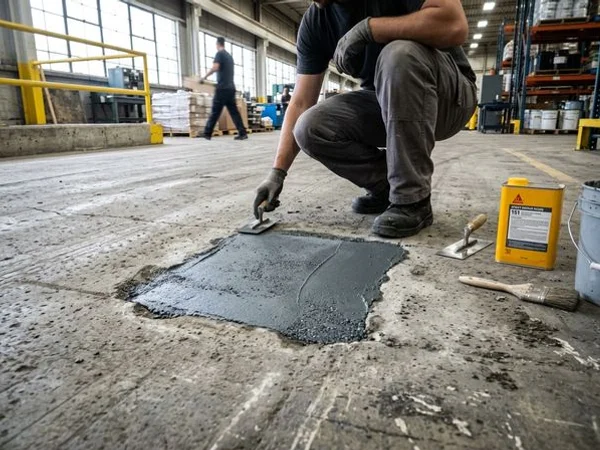
Spall repair follows a different path. Delaminated or hollow areas have to be fully removed back to sound substrate before patching. Shallow spalls up to 25 mm deep get rebuilt in a two-part epoxy mortar at roughly 100 percent solids, which bonds directly to surrounding concrete without a separate bonding agent. Deeper structural spalls, more common in post-war industrial buildings along the Queensway corridor, may need a cementitious polymer-modified repair mortar applied in lifts to avoid shrinkage cracking. Either way, the patched area has to reach a CSP 3 to CSP 5 profile before any primer or basecoat goes down.
Self-Levelling and Substrate Correction
Not every concrete problem is a crack. A meaningful share of residential and light-commercial slabs, particularly poured-in-place basement floors from the 1950s through 1980s in areas like The Glebe and Sandy Hill, have out-of-plane surfaces from differential settlement, heave, or inconsistent original flatwork. A floor that varies by 10 mm or more across a 3-metre straightedge is not suitable for most broadcast flake or metallic epoxy systems, which telegraph any surface irregularity directly to the finished floor.
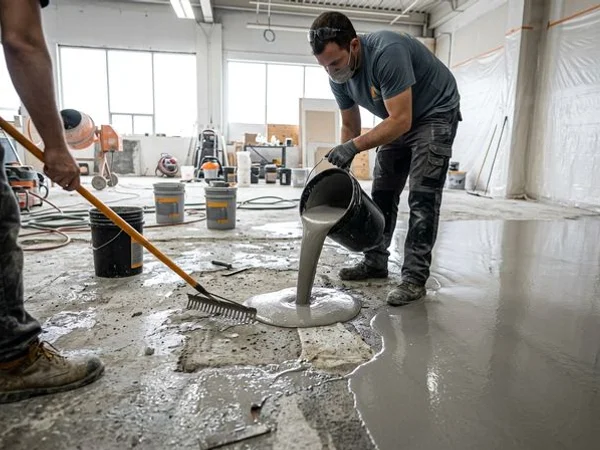
The standard correction is a cementitious self-levelling underlayment (SLU) poured to fill low spots and bring the slab within acceptable tolerance ahead of coating. A quality SLU flows to a feathered edge at 1 to 2 mm and can be built up to 50 mm in a single pour, depending on the formulation. The slab has to be primed with a penetrating epoxy primer before the SLU is poured, both for bond and to prevent the concrete from pulling moisture out of the underlayment too quickly.
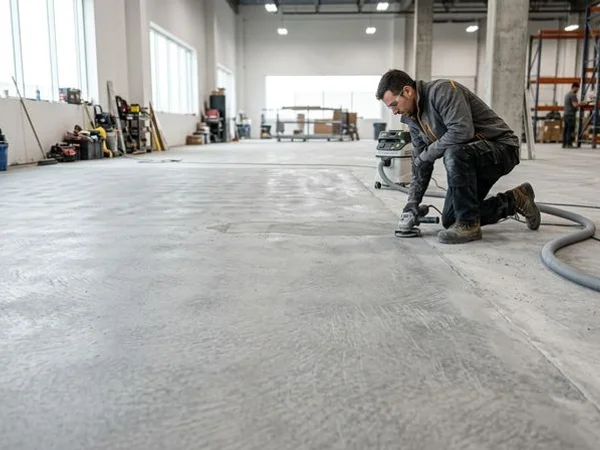
High spots are the opposite problem. A slab carrying prominent aggregate exposure, trowel ridges, or heaved zones from Leda clay movement is ground with a planetary grinder running diamond cup wheels. Grinding also improves adhesion by opening the pores of the concrete, moving the surface from a closed CSP 1 to an open CSP 2 or CSP 3 profile suitable for a 100-percent-solids epoxy primer.
Expansion joints get their own treatment. Fill an expansion joint with rigid epoxy and the coating cracks directly over the joint line as the slab moves seasonally. The correct approach is to honour the joint: clean it out, insert a backer rod if it is deep, and fill with a flexible polyurea joint filler that stays pliable after cure. Expansion-joint repair on a two-car garage floor typically adds $150 to $350 CAD, a small line item that heads off a big cosmetic problem later.
Concrete Repair on Commercial and Industrial Floors
Commercial concrete repair carries higher stakes than residential in two ways. The floor is usually in active service and cannot be closed for a week, and the loads it carries after the repair are far heavier than a residential vehicle. Loading bays in industrial parks along Merivale Road and Hunt Club see forklifts at 8,000 to 12,000 kg gross vehicle weight, riding on hard polyurethane wheels that concentrate that load into a contact patch smaller than a boot heel. A spall patch or crack fill that is not fully bonded to the surrounding substrate shatters under that load within weeks.
For commercial slab repair, a two-part epoxy mortar system with compressive strength above 70 MPa after cure is used, well above the 25 to 35 MPa strength of standard ready-mix concrete. In food-processing facilities and commercial kitchens where daily steam cleaning at high temperature is part of the routine, a novolac epoxy mortar rated for continuous chemical exposure is spec’d rather than a standard bisphenol-A epoxy.
Scheduling is a real constraint on commercial jobs. Most Kanata and Nepean warehouse operators cannot pull a production floor offline for two or three days. Work runs in sections, isolating 20 to 30 percent of the floor at a time, repairing and priming each section overnight, and handing it back to service before the adjacent zone closes. Rapid-set polyurea crack fillers cure to full vehicle load capacity in 30 to 60 minutes, which lets us finish crack repair in one section and have forklifts back on it before the crew moves to the next bay. A written repair sequencing plan lands before work starts so the operations team can coordinate movement without guessing when each zone reopens.
Questions Property Owners Ask
Do my garage cracks need stitching, or just filling?
Cracks wider than 3 mm, cracks with visible vertical or horizontal displacement between the two faces, and any crack that has grown measurably over one or more winters should be stitched with carbon-fibre staples before any fill goes in. Hairline cracks under 1 mm in an otherwise stable slab can be filled with a semi-rigid polyurea without stitching. If you are unsure, a contractor who skips the assessment and quotes fill-only on sight is a red flag.
What does concrete spall repair cost
Spall repair using a two-part epoxy mortar runs roughly $10 to $20 CAD per sq ft of affected area on residential work, driven by depth and access. A typical two-car garage with moderate spalling across 15 to 20 percent of the slab might cost $550 to $1,300 CAD for the repair alone, before any coating. Commercial floors with widespread industrial spalling are priced per sq ft on a project basis.
How long does a full repair and recoat take for a two-car garage?
A two-car garage with moderate cracking and patching, followed by a full epoxy coating build, typically takes two days plus cure time. Day one is crack preparation and stitching, epoxy mortar patching, and diamond grinding. Day two is primer, broadcast basecoat, and topcoat. Light foot traffic is safe 12 to 24 hours after the final coat. Vehicle traffic is safe at 72 hours.
Does the concrete repair actually protect the coating warranty?
Yes, that is precisely why we do it. Coating manufacturers and professional installers void warranties on systems laid over substrates that were not properly prepared. When substrate repair is performed as part of a coating installation, that repair is documented in the project file and the coating warranty covers the entire installed system. Skipping substrate repair to save $300 on a $2,000 floor installation is how homeowners end up with a failed floor and no warranty claim to make.
Our Concrete Repair Results in Ottawa
Concrete Repair Pricing
Why Ottawa Customers Choose Ottawa Epoxy Flooring for Concrete Repair
Prep Saves Floors
Substrate damage is the number one reason coatings fail. We do not shortcut this step.
Carbon-Fibre Stitching
Stops crack propagation. Fill alone often just hides the movement.
Full Range of Repairs
Cracks, spalls, joints, high spots, re-levelling, all handled in-house.
Protects Your Warranty
Coating a bad slab voids warranties. Repair first, coat second.
How Concrete Repair Works
Damage Assessment
Cracks, spalls, high spots, and any moisture flags are documented on site.
Crack Stitching
Carbon-fibre staples plus rapid-set polyurea shut down crack propagation.
Patching + Levelling
Epoxy mortar rebuilds spalled areas; self-levelling underlayment corrects uneven slabs.
Profile for Coating
Diamond grind to the correct concrete surface profile, ready for the new floor.
Ready for a Free On-Site Assessment?
Same-day quotes across Ottawa. WSIB-certified, $2M liability on every project.
What Customers Say About Our Concrete Repair
"Loading bay in our Orleans warehouse had deep spalls running along the dock. Ottawa Epoxy rebuilt them with epoxy mortar to a CSP 4 profile and the repair held through a full freeze-thaw season. WSIB coverage was confirmed before start."
"Two structural cracks ran from the loading bay to mid-floor across our Nepean warehouse slab. Both were stitched with carbon-fibre staples, a large spall by the dock door was patched with epoxy mortar, and a written structural warranty landed at handover. Through a full Ottawa winter, zero movement."
"Straight, no-shortcut crew. Every step got explained, and the Warranty is in writing."
Concrete Repair FAQs
Does my slab actually need concrete repair before epoxy?
If the slab shows visible cracks, spalls, oil-saturated zones, or is out of plane, yes. Coating over damaged concrete is the single most common reason floors fail inside two to three years. We line-item the necessary substrate work in every quote so nothing is a surprise.
Can you repair a slab without coating it?
Yes. Stand-alone concrete repair is offered for slabs that are not being coated, which is common on warehouse floors, exterior pads, and basement slabs where the owner wants raw concrete restored.
Will the cracks come back?
Cracks that are stitched and filled correctly do not propagate. Carbon-fibre staples bridge the crack, and the polyurea fill stays flexible. We do not just smear filler over a moving crack and walk.
How long does the substrate repair itself take?
It depends on damage. A small crack repair is a matter of hours. A full self-levelling underlayment pour on a large slab is a full day plus cure time.
Can you correct sloped or sunken slabs?
Yes. Self-levelling underlayment corrects slope and minor settlement. Severe structural settlement needs its own engineering review.
What should we budget for concrete crack repair in Ottawa?
A standard residential garage crack repair using polyurea fill and carbon-fibre stitching typically runs $300 to $700 CAD depending on crack length and count. Larger commercial or industrial slabs with widespread spalling or full self-levelling underlayment are quoted individually and can land between $1,500 and $8,000 CAD or more. Quotes are broken out line by line so each repair step is priced separately.
What is the difference between polyurea crack fill and epoxy injection?
Polyurea filler is semi-rigid, cures fast (tack-free in 30 to 60 seconds), and tolerates minor crack movement without re-cracking. Epoxy injection is rigid and structurally welds the two crack faces together, which is what you want for structural cracks where zero movement is acceptable. Product selection is driven by crack type, width, and whether the slab is still moving.
How does Ottawa's freeze-thaw cycle drive concrete damage?
Ottawa averages 80 to 100 freeze-thaw cycles per year, which is well above the southern Ontario corridor. That thermal expansion and contraction is the primary driver of crack growth in unheated garages and exterior slabs. Rigid patch materials laid without carbon-fibre stitching commonly re-crack inside one or two winters. Flexible polyurea fills and mechanical stitching are used to accommodate that movement.
Is a permit needed for concrete slab repair in Ottawa?
Cosmetic concrete repair, meaning crack filling, patching, and surface profiling, does not require a City of Ottawa building permit. Structural remediation on a foundation wall or a load-bearing basement slab can require a permit and engineer sign-off. We flag this at the damage assessment stage.
What warranty backs your concrete repair work?
Stand-alone concrete repair is warranted for two years against material failure of the patch or fill under normal use. When repair is performed as part of a full coating installation, the substrate prep falls under the coating warranty, which is a Warranty on residential systems. Warranty terms go to you in writing before work begins.
When can we coat the concrete after repairs are done?
Rapid-set polyurea crack filler is overcoat-ready in 30 to 60 minutes. Epoxy mortar patches are typically walk-ready in 4 to 6 hours and coating-ready in 12 to 24 hours. Cementitious self-levelling underlayment needs a full 24-hour cure before any coating or primer touches it. Coating work is scheduled around these cure windows, so there is no delay in the overall project.
Do you handle commercial and industrial repair?
Yes. We work in warehouses, food-processing facilities, retail centres, and light manufacturing across the National Capital Region. Commercial repairs run the same ASTM standards for surface profiling and patch compatibility as residential, and we carry the insurance and WSIB coverage commercial job sites require.
Concrete Repair & Restoration by city
Local pages with area-specific detail across the NCR:
Concrete Repair & Restoration in Ottawa
Local concrete repair for Ottawa homes and businesses.
Learn more →Concrete Repair & Restoration in Kanata
Local concrete repair for Kanata homes and businesses.
Learn more →Concrete Repair & Restoration in Nepean
Local concrete repair for Nepean homes and businesses.
Learn more →Concrete Repair & Restoration in Barrhaven
Local concrete repair for Barrhaven homes and businesses.
Learn more →Concrete Repair & Restoration in Orleans
Local concrete repair for Orleans homes and businesses.
Learn more →Concrete Repair & Restoration in Gatineau
Local concrete repair for Gatineau homes and businesses.
Learn more →Concrete Repair & Restoration in Rockcliffe Park
Local concrete repair for Rockcliffe Park homes and businesses.
Learn more →Concrete Repair & Restoration in Vanier
Local concrete repair for Vanier homes and businesses.
Learn more →Concrete Repair & Restoration in Westboro
Local concrete repair for Westboro homes and businesses.
Learn more →Concrete Repair & Restoration in The Glebe
Local concrete repair for The Glebe homes and businesses.
Learn more →Related Services
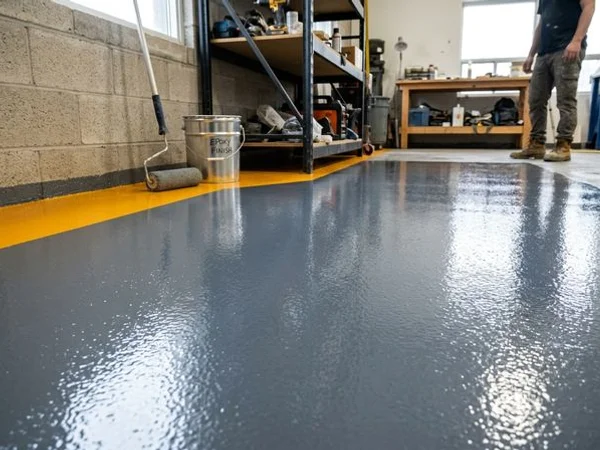
Epoxy Floor Repair & Recoat in Ottawa & the National Capital Region
Full mechanical removal of failed or peeling epoxy back to bare concrete, an ASTM F2170 moisture re-test, and a fresh 100% solid system rated for 10 to 15-plus years on a correctly profiled CSP 3 slab. A full recoat runs $3 to $7 per sq ft installed. Most residential garage repairs wrap inside a two-day window. Root cause is diagnosed first so the new floor does not fail the same way.
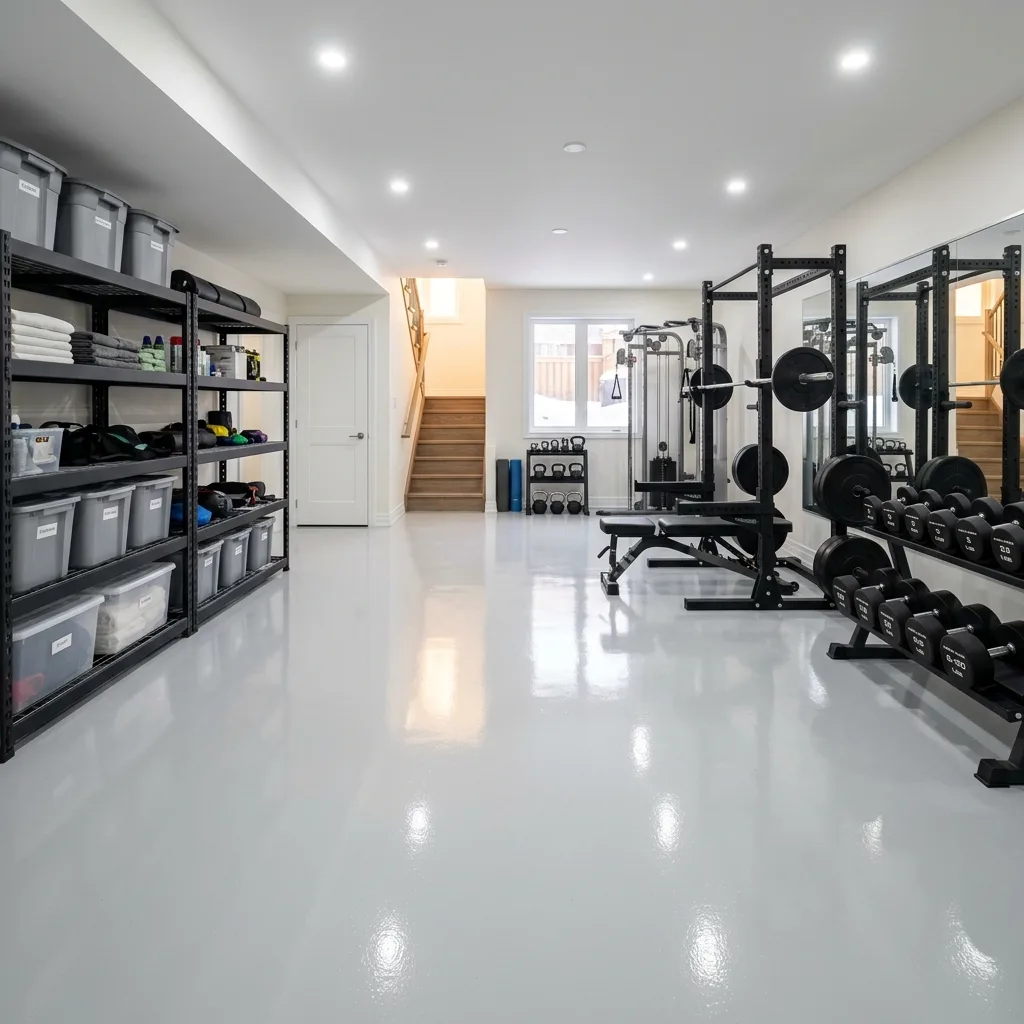
Basement Epoxy Flooring in Ottawa & the National Capital Region
Seamless zero-VOC epoxy floors for NCR basements, engineered around the Leda clay vapour drive that destroys ordinary coatings below grade. Every slab gets 72 hours of ASTM F2170 in-situ humidity testing before a drop of primer goes down. Pricing runs $4 to $13 per sq ft installed, most 600 sq ft basements finish in two working days, and the zero-VOC chemistry stays safe for occupied homes. WSIB-certified crews on every install.
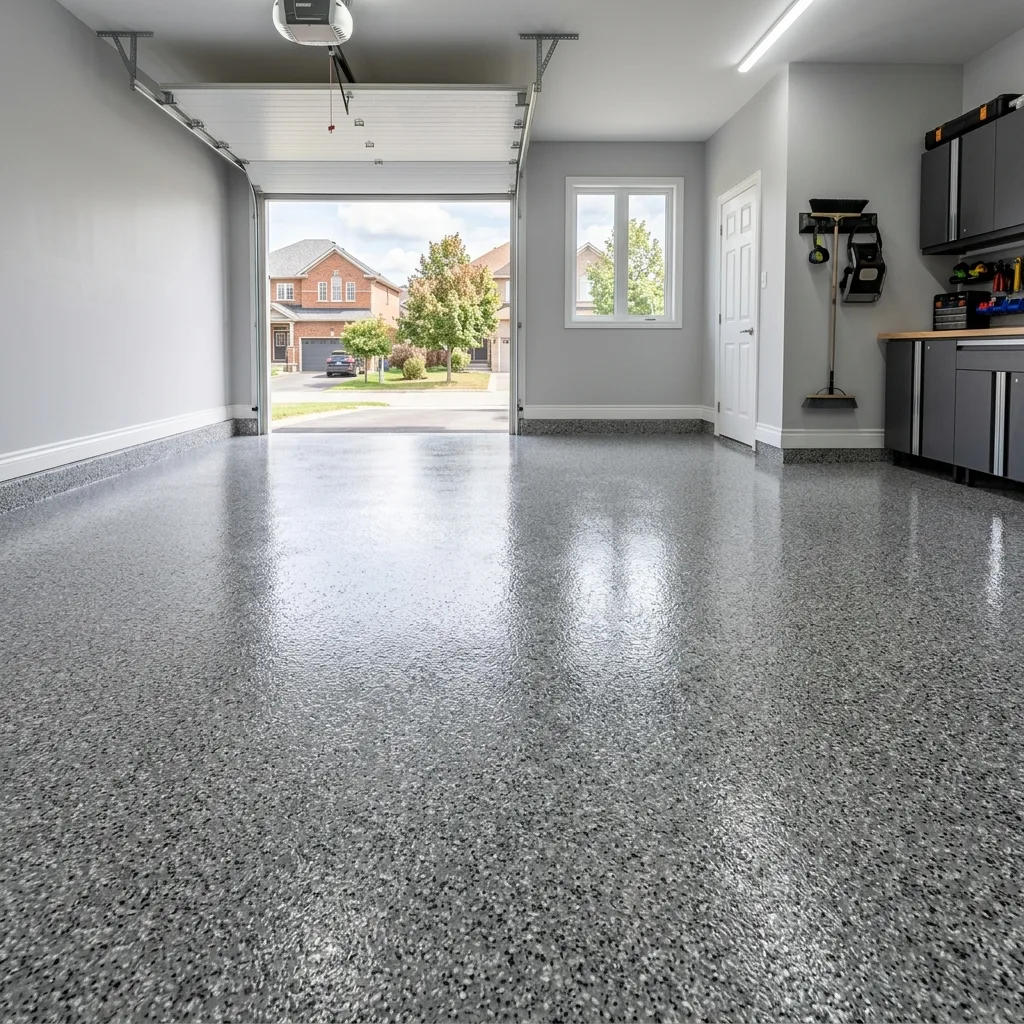
Outdoor Patio Epoxy Coating in Ottawa & the National Capital Region
For NCR pool decks, patios, and walkways, our aliphatic polyaspartic exterior coating is engineered to survive 80 to 100 freeze-thaw cycles per winter, road salt chloride loads, and pool chemistry without amber yellowing. A 400 sq ft residential deck typically completes in 2 days at $2,400 to $4,400 installed, including sealed expansion joints and quartz aggregate broadcast for wet-area traction.
Ready to Book Concrete Repair?
Same-day free on-site assessment. WSIB-certified, $2M liability on every project.