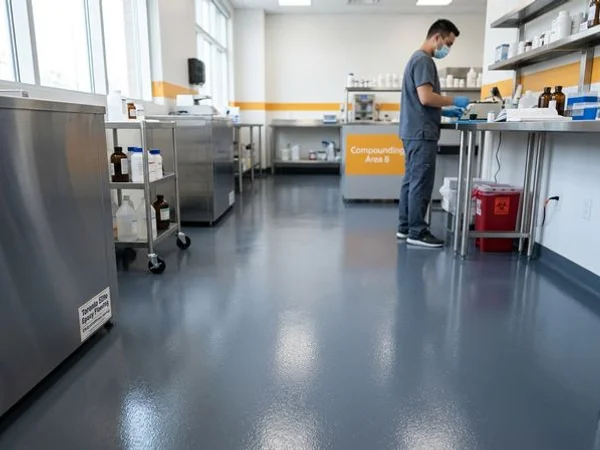
Laboratory Epoxy Flooring in Ottawa & the National Capital Region - Chemical-Resistant & Anti-Static Research Lab Floors
For NCR research and pharmaceutical operators, Ottawa Epoxy Flooring installs novolac chemical-resistant epoxy systems, seamless sanitary coving, and anti-static floor coatings. Our clients include federal research laboratories, University of Ottawa and Carleton University science facilities, clinical testing labs, pharmaceutical QC labs, and industrial materials testing operations. Every laboratory project runs CSP 3 surface preparation, ASTM F2170 moisture verification, and chemical resistance validation matched to the specific reagent and solvent profile on site.
Laboratory floors face chemical exposure that ordinary bisphenol-A epoxy cannot survive. Novolac epoxy, produced from phenol-formaldehyde condensation rather than bisphenol-A synthesis, carries a higher crosslink density and delivers significantly better resistance to concentrated sulphuric acid, hydrochloric acid, sodium hydroxide, acetone, methanol, ethanol, and halogenated solvents. These are the working fluids of a real analytical chemistry or research lab. Standard 40 to 60 percent solids epoxy softens and blisters under repeated solvent spill exposure inside 12 to 24 months. Novolac systems typically hold their integrity 8 to 15 years under the same conditions. Anti-static topcoats are required in any lab handling flammable solvents with auto-ignition risk below 100 C, to comply with NFPA 45 laboratory fire code and Ontario Fire Code Section 5.12.
Laboratory projects typically span 500 to 3,000 sq ft and finish in phased overnight or weekend shifts to minimise research downtime. Pricing runs $10 to $18 per sq ft installed, driven by chemical resistance specification, anti-static requirements, and coving complexity. Chemical resistance data sheets and installation records ship with every project handover.
Ottawa Epoxy Flooring provides laboratory epoxy flooring across the National Capital Region, including Kanata, Nepean, Orleans, Barrhaven, Stittsville, Gatineau, Kemptville, Arnprior, Rockland, and Manotick.
Laboratory Epoxy Flooring in Ottawa
Ottawa Epoxy Flooring installs novolac chemical-resistant floor systems for research laboratories, university science facilities, clinical testing labs, and pharmaceutical quality control environments across the National Capital Region. Our seamless novolac base coats and anti-static topcoats resist the concentrated acid, base, and solvent exposure that degrades standard epoxy in 12 to 24 months.
What Is Laboratory Epoxy Flooring?
Laboratory epoxy flooring is a seamless, chemically resistant floor system engineered for the concentrated acid, solvent, and reagent exposure found in research, clinical, and industrial testing environments. Novolac epoxy, with a higher crosslink density than standard bisphenol-A systems, is the industry standard wherever floor integrity under chemical spill conditions is a safety and regulatory requirement.
What Does a Laboratory Epoxy System Include?
- CSP 3 diamond-ground surface preparation
- Novolac epoxy base coat (chemical resistance validated against reagent profile)
- Anti-static topcoat for flammable solvent environments (NFPA 45 compliant)
- Integral 4 to 6 inch sanitary coving
- Seamless floor-to-drain transitions
- Chemical resistance documentation and installation records
How Much Does Laboratory Epoxy Cost
Laboratory epoxy runs $10 to $18 per sq ft installed in the NCR. Chemical resistance specification, anti-static requirements, and coving complexity move the final number. Most projects run 500 to 3,000 sq ft.
Why NCR Research and Institutional Facilities Need Specialist Lab Flooring
Ottawa is home to a concentration of federal research laboratories, university science facilities, and pharmaceutical operations that rivals any Canadian city outside Montreal and Toronto. The National Research Council, University of Ottawa, Carleton University, and the Kanata tech corridor all house laboratory environments where floor failure under chemical exposure creates safety risk and regulatory non-compliance. Standard commercial epoxy, adequate for office corridors and retail spaces, degrades within 12-24 months under the solvent and acid exposure that is routine in analytical chemistry, pharmaceutical QC, and materials testing.
Local substrate conditions add another layer of complexity. Many laboratory buildings in the downtown core and on university campuses are mid-20th-century slab-on-grade construction, poured on Leda clay without modern vapour barriers. ASTM F2170 moisture testing frequently returns elevated in-slab humidity that requires a moisture-tolerant primer before any novolac system can be applied. Skipping that step is the number-one cause of coating failure inside the first two years on a local lab slab.
Novolac Epoxy Systems for Chemical Resistance
Our novolac epoxy systems are built on phenol-formaldehyde condensation polymers, which produce a tighter molecular network than standard bisphenol-A epoxies. That higher crosslink density improves resistance to chemical diffusion and softening. Under repeated solvent exposure, standard epoxies typically show visible degradation inside 12 to 24 months; novolac systems typically hold structural integrity for 8 to 15 years in a real laboratory environment.
| Epoxy Type | Chemical Network | Typical Service Life | Solvent Resistance |
|---|---|---|---|
| Standard Bisphenol-A | Linear crosslinking | 1-2 years | Moderate |
| Novolac Phenol-Formaldehyde | Multi-ring dense matrix | 8-15 years | Excellent |
Surface preparation is verified with CSP 3 diamond grinding for adhesion, and ASTM F2170 in-situ moisture testing is run on every slab. Those two steps let the resin fully cure and produce a stable bond line that survives temperature cycling.
Anti-Static Topcoat for Flammable Solvent Environments
For facilities handling flammable solvents, ESD-dissipative topcoats with controlled surface resistivity are installed. These coatings suppress static build-up and prevent discharge that could ignite volatile vapour, satisfying NFPA 45 and Ontario Fire Code Section 5.12. Each formulation maintains auto-ignition suppression below 100 C, holding a safety margin above the room temperatures typical of solvent storage and dispensing areas.
The anti-static film bonds over the novolac base without giving up any chemical resistance. It holds up under continuous foot and cart traffic in industrial testing areas and analytical labs. Combined with phased overnight installation, this approach preserves certified thermal safety and solvent immunity while keeping operations running.
Research Labs, Clinical Facilities, and Industrial Testing
University and Government Research Laboratories
Laboratory floor systems are designed for research spaces where high solvent exposure and continuous foot traffic are daily reality. University of Ottawa and Carleton University science buildings, together with National Research Council facilities in the core, handle concentrated acids and common solvents every shift. Every install satisfies NFPA 45 laboratory fire code and Ontario Fire Code Section 5.12 covering flammable solvent storage.
Integral sanitary coving 4 to 6 inches up the wall and seamless transitions around floor drains maintain a hygienic, containment-quality environment. Overnight phasing keeps laboratory work moving.
Clinical and Pharmaceutical QC Labs
Our epoxy systems for clinical testing labs and pharmaceutical QC environments put safety, chemical cleanliness, and low maintenance first. Sub-slab conditions are confirmed with ASTM F2170 in-situ relative humidity testing before installation. Every project meets WSIB certification standards and carries $2M liability coverage.
Industrial Materials Testing Applications
In industrial test labs and materials analysis environments, mechanical impact and chemical loading push flooring to its limits. Our industrial-grade flooring systems resist abrasion, dropped-tool damage, and daily exposure to toluene, xylene, and halogenated solvents. Performance flooring is deployed with integral coving, sloped floor-to-drain transitions, and anti-static top layers that shield sensitive instrumentation from electrostatic discharge.
Installation Process and Compliance
CSP 3 Diamond Grinding and Moisture Testing
Every install starts with CSP 3 diamond grinding, verified for profile consistency before any resin is opened. Vacuum-assisted grinders protect air quality in occupied facilities. Before priming, technicians inspect for cracks and vapour transmission points; any voids are filled with epoxy mortar so the substrate absorbs uniformly.
ASTM F2170 in-situ relative humidity testing runs 48 hours after core drilling to confirm slab equilibration. Readings need to sit below 75 percent RH, or below the manufacturer’s tolerance for the specified novolac system. Elevated results trigger vapour mitigation primers or an extended drying window before coating.
Integral Sanitary Coving and Seamless Transitions
Sanitary coving 4 to 6 inches up the wall is hand-troweled at every wall base using epoxy mortar shaped into a continuous curve. The result is a single monolithic surface with no seam between floor and cove.
| Feature | Purpose | Typical Height |
|---|---|---|
| Integral Coved Base | Prevents fluid retention | 4-6 in. |
| Seamless Floor-to-Drain | Eliminates grout joints | Continuous slope |
Phased Overnight Installation
Research and clinical labs frequently run continuously. Phased overnight installation is coordinated to avoid downtime while preserving daytime access for essential work. One zone is isolated per night behind portable containment walls with negative-air filtration. By morning, each section reaches walkable hardness.
Related Questions Lab Managers Ask
Does a university research lab need the same epoxy spec as a pharmaceutical QC lab?
No. A university chemistry research lab handling mixed solvents needs novolac epoxy for chemical resistance, but typically does not need GMP material traceability documentation. A pharmaceutical QC lab under GMP guidelines needs the same novolac chemistry plus ESD-dissipative topcoats for weighing equipment, full material traceability records, and documentation structured for Health Canada audit review. The actual regulatory environment is assessed first.
Why does CSP 3 grinding matter more in labs than in commercial spaces?
Lab floors take chemical permeation from repeated solvent and acid spills on top of mechanical loading. A CSP 2 surface does not provide the anchor profile novolac needs under combined chemical and thermal cycling. We have inspected failed lab floors where the previous installer stopped at CSP 2 and the coating delaminated at the bond line inside 18 months of solvent exposure. CSP 3 is non-negotiable for novolac in a real lab environment.
What happens when lab operations change and the solvent inventory shifts after the floor is installed?
Novolac epoxy covers a broad chemical resistance spectrum. When your lab adds a new solvent class, compatibility can be tested against the installed system’s chemistry data sheet before it becomes a floor problem. If the new chemistry falls outside the installed resistance range, a topcoat upgrade or barrier layer can usually be specified rather than a full floor replacement.
How long after installation can a lab return to full solvent use?
Novolac systems reach walkable hardness inside 12 to 18 hours. Full chemical resistance cure takes 5 to 7 days at standard lab temperatures. A phased return-to-service protocol is delivered at handover: light foot traffic after 24 hours, cart and equipment traffic after 48 to 72 hours, full chemical exposure after 7 days.
Laboratory Epoxy Pricing
Chemical resistance spec and anti-static requirement drive the final number.
Why Ottawa Customers Choose Ottawa Epoxy Flooring for Laboratory Epoxy
Novolac Chemistry Baseline
The tighter crosslink density of phenol-formaldehyde novolac gets you an 8 to 15 year run against reagents that eat standard bisphenol-A inside two years.
Ignition-Class Static Control
Static-dissipative topcoat resistance windows are matched to the auto-ignition profile of your specific solvents under NFPA 45 and Ontario Fire Code Section 5.12.
Cove Included in Base Price
Every install ships with the hand-troweled four to six inch integral cove already scoped, never billed as a change order.
Research Never Stops
Small bay-by-bay sequencing under portable containment tents keeps fume hoods and benches running while the crew works the adjacent floor.
How Laboratory Epoxy Works
Reagent & Chemical Profile Assessment
Walk-through with your safety officer covers the SDS binder, flammable class handling, drain routing, and static discharge zones. Novolac tier and anti-static topcoat get locked before scoping the timeline.
CSP 3 Prep & Moisture Testing
Planetary diamond grind to a CSP 3 profile, 48-hour equilibrated ASTM F2170 relative humidity readings, condition logging of the slab, and epoxy mortar void fill in advance of any coat.
Phased Overnight Application
Novolac base, ESD-tuned topcoat, and hand-troweled four to six inch integral cove all installed one bay at a time. Negative-air containment walls keep the adjacent research zone running through the night.
Compliance Documentation Package
Handover binder includes the chemical resistance cross-reference against your reagent list, F2170 moisture logs, CSP profile records, batch traceability, and full WSIB paperwork.
Ready for a Free On-Site Assessment?
Same-day quotes across Ottawa. WSIB-certified, $2M liability on every project.
What Customers Say About Our Laboratory Epoxy
"I manage the analytical chemistry labs at a Kanata research facility. For years the epoxy floor around our solvent fume hoods was degrading every 18 months. Ottawa Epoxy spec'd a novolac phenol-formaldehyde system with the right anti-static topcoat for our acetone and IPA handling zones, ran the install over a long weekend in overnight phases, and handed our safety officer the chemical resistance documentation she needed. Two years in, zero degradation."
"Our Nepean pharmaceutical QC lab needed flooring that would clear an internal GMP audit. Ottawa Epoxy understood the difference between a university research lab and a GMP QC environment. They spec'd the ESD-dissipative topcoat in the correct ohm range for our weighing benches and delivered full material traceability. The sanitary coving is flawless. The auditor had no comments on the flooring."
"Industrial materials testing lab in Orleans running toluene and xylene exposure tests daily. The old standard epoxy was blistering badly. Ottawa Epoxy switched us to a novolac system and the difference is night and day. Fourteen months of harsh solvent exposure later and the floor still looks like day one. The phased overnight install meant we never had to close the lab."
Laboratory Epoxy FAQs
What epoxy is used in research and clinical laboratories?
Laboratory floors need novolac epoxy base coats rather than standard bisphenol-A systems. Novolac delivers significantly higher crosslink density and resistance to concentrated acids, bases, ketones, and halogenated solvents that break down standard epoxy inside 12 to 24 months. Anti-static topcoats are added in labs handling flammable solvents below 100 C auto-ignition threshold, to satisfy NFPA 45 and Ontario Fire Code Section 5.12.
How does novolac phenol-formaldehyde epoxy compare to bisphenol-A in crosslink density and solvent resistance?
Novolac epoxy forms through phenol-formaldehyde condensation rather than bisphenol-A synthesis, producing a multi-ring dense molecular network with significantly higher crosslink density. That tighter network slows solvent diffusion and prevents the softening, blistering, and micro-cracking that standard bisphenol-A shows under repeated acid and solvent exposure. Bisphenol-A systems typically degrade inside 12 to 24 months in lab environments; novolac systems maintain structural integrity for 8 to 15 years under the same conditions.
What resistance can be expected against toluene, xylene, and halogenated solvents?
Novolac epoxy holds up against toluene, xylene, dichloromethane, chloroform, and most halogenated hydrocarbons common in pharmaceutical QC and analytical research labs. Your specific solvent list is reviewed during the pre-install assessment and chemical compatibility is confirmed before the coating system is specified.
What NFPA 45 and Ontario Fire Code Section 5.12 requirements apply to lab flooring?
NFPA 45 and Ontario Fire Code Section 5.12 require laboratory flooring in flammable and combustible liquid storage and use areas to mitigate static discharge ignition risk. That means anti-static ESD-dissipative topcoats are required in any lab zone where flammable solvents with auto-ignition below 100 C are handled.
How is a 4 to 6 inch integral sanitary cove built?
Sanitary coving is hand-troweled using the same epoxy mortar as the floor, not a separate vinyl cove base that can lift or trap bacteria behind it. The mortar is shaped to a continuous radius at every wall-floor junction, typically 4 to 6 inches tall, producing a seamless transition that can be washed from wall to drain without fluid retention in corners.
Can lab flooring be installed without shutting the facility down?
Yes. Laboratory projects are scheduled in phased overnight or weekend shifts so research operations continue throughout. Each section is isolated behind portable containment walls with negative-air filtration, installed, cured, and verified before the next section begins.
How much does laboratory epoxy flooring cost in Ottawa?
Laboratory epoxy runs $10 to $18 per sq ft installed in the NCR. Standard epoxy with an anti-static topcoat sits at $10 to $12; novolac systems for heavy chemical exposure sit at $14 to $18. Integral sanitary coving up to 6 inches is included. Most projects run 500 to 3,000 sq ft.
What chemical resistance does novolac epoxy provide?
Novolac epoxy systems hold up against concentrated sulphuric acid, hydrochloric acid, dilute nitric acid, sodium hydroxide, acetone, methanol, ethanol, isopropyl alcohol, toluene, xylene, and most halogenated solvents common in analytical and research laboratory work.
Is university laboratory flooring different from pharmaceutical lab flooring?
University research labs typically need broad-spectrum chemical resistance without GMP documentation. Pharmaceutical QC labs need GMP documentation, material traceability, and in many cases ESD-dissipative topcoats for static-sensitive instrumentation. The system is specified for the facility type and documentation is scaled to the regulatory environment.
Related Services
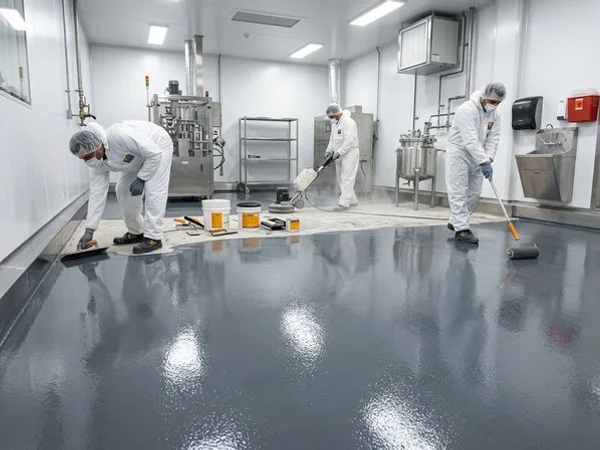
Pharmaceutical Cleanroom Epoxy Flooring in Ottawa & the National Capital Region
Novolac base coats, ESD-dissipative topcoats, and zero-particle-emission chemistry engineered for ISO 5 to 8 pharmaceutical cleanrooms, compounding pharmacies, and Health Canada-licensed drug premises across Ottawa and the National Capital Region. Installed pricing $12 to $20 per sq ft; phased overnight scheduling preserves cleanroom classification throughout. WSIB coverage, $2M commercial general liability, and a complete GMP compliance package accompany every project.

Commercial Epoxy Flooring in Ottawa & the National Capital Region
Commercial floor systems engineered around the regulatory frameworks that govern federal facilities, restaurants, hospitals, and tech-corridor manufacturing across the National Capital Region. CFIA-compliant kitchens, IPAC Canada coved medical floors, ISO 14644-1 cleanrooms, and high-crossing retail systems. Installed pricing from $5 per sq ft on open warehouses to $22 per sq ft on cleanroom builds. WSIB-certified, $2M liability, full compliance documentation.
ESD Conductive Epoxy Flooring in Ottawa & the National Capital Region
Anti-static and conductive epoxy floors for federal facilities, Kanata electronics manufacturers, and NCR data centres. Copper grounding grid, ANSI/ESD S20.20 spec, megohmmeter-verified at handover. Installed cost $7 to $14 per sq ft, with a signed compliance report on every job.
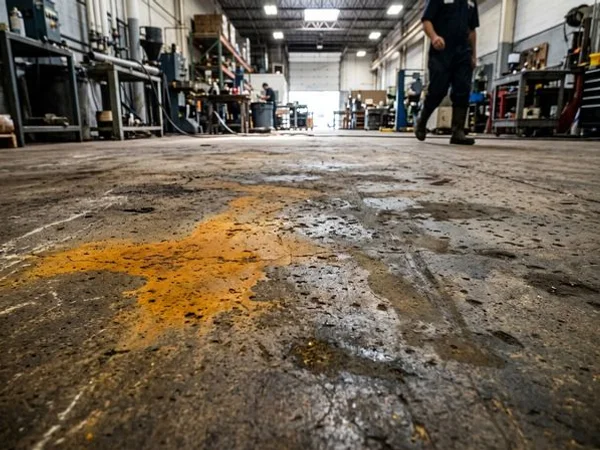
Secondary Containment Coatings in Ottawa & the National Capital Region
Immersion-rated novolac epoxy, vinyl ester, and polyurea secondary containment coatings for fuel tank berms, chemical storage rooms, transformer pads, and industrial spill floors across Ottawa and the NCR. TSSA-compliant, chemical-profile-specific specifications. From $10 to $18 per sq ft installed with full compliance documentation, WSIB certification, and $2M liability on every project.
Institutional & Medical Epoxy Flooring in Ottawa & the National Capital Region
Seamless antimicrobial epoxy with 4 to 6 inch integral wall coving and zero-VOC chemistry for Ottawa hospitals, clinics, schools, and long-term care operators. Installed pricing $6 to $12 per sq ft; section-by-section scheduling keeps the facility running. WSIB-certified crews, $2M liability, and full IPAC Canada compliance paperwork on every project.
Ready to Book Laboratory Epoxy?
Same-day free on-site assessment. WSIB-certified, $2M liability on every project.